
CDPHE proposes verification that MEAN’s clean energy plan meets statutory threshold; PUC requests annual written updates
Get AI-powered insights, summaries, and transcripts
Subscribe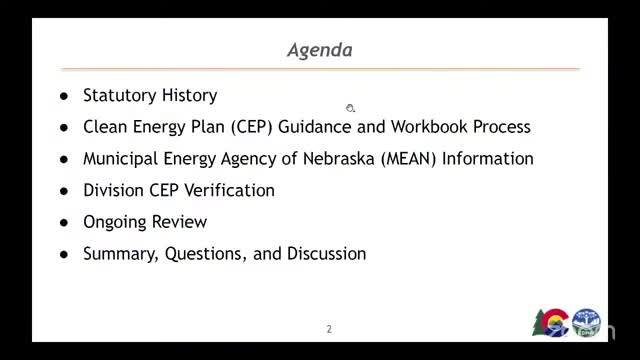
Summary
The Colorado Department of Public Health and Environment’s Air Pollution Control Division said it will verify that the Municipal Energy Agency of Nebraska’s voluntary clean energy plan achieves at least an 80% reduction in greenhouse-gas emissions from its Feb. 2005 baseline, and that the division will file a final verification report in the Public Utilities Commission’s informational docket by the end of the month.
The Colorado Department of Public Health and Environment’s Air Pollution Control Division said it will verify that the Municipal Energy Agency of Nebraska’s voluntary clean energy plan achieves at least an 80% reduction in greenhouse-gas emissions from its Feb. 2005 baseline, and that the division will file a final verification report in the Public Utilities Commission’s informational docket by the end of the month.
Mr. Korth, a staff member of the Colorado Air Pollution Control Division, told the Public Utilities Commission at a commissioner information meeting that his division published a draft verification and is proposing to verify that MEAN “will achieve an 80% or greater reduction, from their 02/2005 baseline levels.” He said the division’s draft lowered MEAN’s originally submitted figure of 83% to 80% after identifying additional energy and emissions that needed to be removed from MEAN’s baseline calculations.
The verification applies to MEAN’s wholesale supply to Colorado only. MEAN does not operate generation inside Colorado and supplies electricity to 14 small Colorado utilities. The division said those Colorado customers are individually below statutory thresholds that would require separate clean energy plans and that MEAN’s Colorado sales amount to “approximately 1%, just a slightly above 1%, of Colorado electricity consumption, annually.”
CDPHE staff described the statutory and administrative framework the division used: guidance and a verification workbook developed in 2020, the clean energy plan process created by earlier legislation, updates to voluntary CEP requirements in 2021, and additional transparency and filing requirements from 2023 legislation. The division said it uses a single published workbook to standardize inputs, emission factors and conversions and to avoid double counting between wholesale and retail sales.
Under the division’s described process, staff will track MEAN’s interim-year values annually using data submitted under Regulation 22 and a supplemental data form for imported energy. If a utility is off track for two consecutive years, the division said it is obligated to consult with the Air Quality Control Commission and could require MEAN to file a new plan to regain compliance. The division also said it will perform a 2027 verification that the resources proposed in the plan will be in service and delivering energy to Colorado in 2030.
Commissioners asked how the commission will receive ongoing updates about MEAN’s compliance. Commissioner Gohman and Commissioner Gilman said they would welcome written updates rather than regular in-person briefings. Mr. Korth offered to provide the same written updates the division supplies to the Air Quality Control Commission, saying those updates typically are given in September or October each year.
Commissioner Plant asked whether MEAN’s nuclear and other regional resources were included in Colorado calculations. CDPHE staff said MEAN’s nuclear assets largely serve the MISO market and were not counted as resources that can supply Colorado; the division said MEAN used resources that can supply Colorado when completing the workbook. The division also said MEAN’s coal resources in Wyoming are being transitioned to wind, solar and battery projects, which is reflected in the emissions reductions the division verified for Colorado sales.
CDPHE held a public meeting on the draft verification last week with three participants, the division said. The public comment period opened in February and was scheduled to close the day after the informational briefing. With the planned close of public comment and the consultation briefing before the commission, CDPHE said two of the three required public elements for the 2023 legislation will be complete; CDPHE will submit the final verification report to the PUC informational docket by the end of the month.
The division and commissioners discussed organized-market implications. Commissioners asked whether MEAN and the 14 municipal customers would be affected by markets such as SPP RTO West or a markets-plus construct. CDPHE staff said MEAN currently operates across MISO, SPP and the Western Interconnection and that market alignment will be relevant to future calculations and planning, but did not identify a binding membership decision for MEAN or the municipal customers that would change the present verification.
No formal vote or PUC action occurred during the meeting. The briefing closed with agreement to provide written updates on MEAN’s progress and for CDPHE to submit its final verification report into the informational docket.