
PUC task force outlines oversight of jail phone services, agrees to continue quarterly meetings
Get AI-powered insights, summaries, and transcripts
Subscribe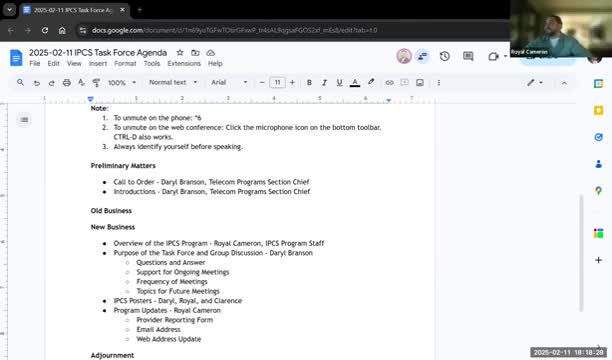
Summary
Public Utilities Commission staff described quarterly reports, biannual testing and a consumer-complaint system for the Incarcerated People’s Communication Services program, sought feedback on posters for facilities, and the group agreed to meet quarterly going forward.
Royal, a member of the Public Utilities Commission’s Incarcerated People’s Communication Services (IPCS) team, told attendees the program oversees providers and testing of in‑facility phone and video services and publishes reports and complaint data to increase transparency.
Royal said, “we're overseeing a total of 12 providers within the state of Colorado, and we're overlooking 85 incarcerated people's facilities.” He described three core program activities: quarterly reporting from providers (call volumes, revenues, rates, commissions and provider contracts), biannual randomized testing of facility systems over a two‑year cycle to validate connection quality and reported rates, and a public consumer‑complaint questionnaire and dashboard that strips identifying information before publication.
The IPCS staff also summarized recent rulemaking and operational changes. Royal said the group recently completed a statutory rulemaking to clarify definitions, reporting and testing requirements, provider website notification placement and penalty processes for noncompliant providers. He said the program will adopt updated quarterly reporting spreadsheets and move the file upload process from box.com into the PUC’s e‑filing system; a how‑to video for providers is being prepared. Daryl, PUC staff, was identified as producing the instructional video.
PUC staff presented draft flyers and posters intended to inform families, visitors and incarcerated people about how to submit complaints and access IPCS resources. The posters include a PUC web address and a QR code; staff said placement would be voluntary and left to individual facilities.
Stacy Schafer, contract administrator at Larimer County Jail, cautioned against relying on a QR code for people inside facilities: “I'm not sure it's gonna be useful, because at least for the facilities that we provide, the incarcerated don't have access to the Internet and they usually don't have a device with a camera to be able to scan the QR code.” She suggested posters would be most useful in visitor lobbies and for family members. Max Stager, a parent and Colorado Cure board member, and other family advocates said many complaints arrive via handwritten letters and that printed mailing addresses or PDFs uploadable to in‑facility vendor apps would help inmates file complaints.
Ebony White, a community ambassador and advocate for people with incarcerated loved ones, proposed an in‑call or tablet survey to collect immediate feedback: “So maybe right after a phone call or maybe once a week, it's sent to, like, their tablets or it's on the kiosk when they log in. It asks them, and then it's like, thank you, with their inmate number or with their information. Your, feedback was received or something.” Providers and facility staff replied that most facilities operate a local grievance process that initially handles complaints on site and that any off‑site submission usually must follow that process first.
Clarence, identified as PUC staff, summarized the preferred complaint sequence: “we would like it to be directed initially to the provider to give them an opportunity to address the issue. But then if that does not happen in a fashion that you feel is timely or productive, then we definitely want to hear from folks.” Royal and Clarence said the IPCS complaint questionnaire already asks whether complainants contacted the provider and requests contact information when available.
Providers on the call asked that the complaint form make clear the required steps and contact fields so providers have the opportunity to resolve issues before PUC involvement. Angela Collins, outside counsel for Global Telinc Corporation (DBA BiPath Technologies), asked that updated reporting instructions be distributed broadly; Royal said staff will email the updated Excel template and e‑filing instructions to known contacts and post materials on the IPCS program page.
Participants discussed meeting cadence and format. The group expressed support for continuing the task force; attendees recommended starting quarterly meetings, alternating day and evening times to accommodate both advocates and working providers. Lance Alexander, chief of detentions at the Hora Detention Center, called the forum “beneficial” because of the meeting’s diverse participation.
PUC staff said posters and accessibility are priorities: participants urged accessible color contrast, screen‑reader remediated PDFs for web posting, and alternate complaint submission methods for incarcerated people who lack internet or cameras. Royal and PUC staff committed to incorporate that feedback in the poster content and distribution plan.
Ending: PUC staff said they will send calendar invites for future meetings, post meeting notices on the IPCS program page, email the updated reporting template and e‑filing instructions to providers, and continue scheduling future meetings on a quarterly basis. No formal vote was taken; the group indicated general support for the plan during the discussion.