Get Full Government Meeting Transcripts, Videos, & Alerts Forever!
Get email alerts on the Woodstock Road Realignment topic
No spam. Unsubscribe anytime.
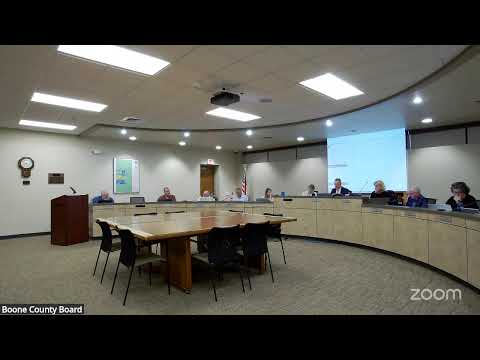
Boone County hires consultant for Woodstock Road corridor study; public raises farmland concerns
Summary
The county selected a consultant and approved a contract to study Woodstock Road realignment options after residents urged alternatives to minimize loss of productive farmland.
Boone County approved hiring a consultant and authorizing a contract to study options for the Woodstock Road corridor realignment, a multi-phase project that could change how Woodstock, Caledonia and other local roads connect to Highway 76.
Justin (county staff) told the board the vote authorizes a consultant to perform a corridor study and public-engagement steps required under federal funding rules. The study will evaluate multiple options, including a no-action alternative and several realignment concepts the county has discussed with the Illinois Department of Transportation (IDOT).
Public comments at the meeting focused on farmland impacts. Several residents with nearby fields said the draft southern Woodstock alignment would fragment productive 40-acre parcels and increase headland lengths for farm machinery, reducing efficiency and farmable acreage. Grant Anderson provided a diagram and said the Woodstock realignment would consume roughly 40 acres of land on the east McKinley parcel, while a Caledonia realignment would affect materially fewer acres. Garrett Halstead and Emily Mayo (Veil) spoke for farm families who prefer alternate alignments or asked to be included in negotiations should right-of-way or eminent-domain actions occur.
The board proceeded to a qualifications-based selection (QBS) process the county had run earlier. Two firms submitted final contracts; Willett Hoffman scored highest in the county's scoring process and (after an amendment to the selection motion) the board voted to select Willett Hoffman to perform phases 1 and 2. The board then approved the consultant contract for design and public-engagement phases.
Justin told the board federal funding (an 80% grant allocation through the Metropolitan Planning Organization / Surface Transportation Block Grant program) is available for phases 1 and 2, but stressed that approval tonight does not select a final roadway alignment or authorize property acquisition. He said work must begin promptly to be shovel-ready for construction projected in 2027 and that the corridor study will include federally required environmental reviews and public hearings.
Board members repeatedly said the corridor study aims to reduce conflict points and improve safety by reducing the number of intersections. Several members who represent rural districts emphasized they wanted the study to ensure farmland impacts are minimized and that property owners are fully consulted as the process advances.
The board recorded a roll-call approval to select the consultant (Willett Hoffman) and to contract for phases 1 and 2; the clerk recorded "motion carries" for both items. Staff said the next steps include corridor-level alternatives, outreach to IDOT and property owners, and follow-up board briefings once options are narrowed.