
Nashville awarded $11.8 million in CoC funding; collaborative applicant role transfers to OHS and payment of lived‑experience roles limited by Metro charter
Get AI-powered insights, summaries, and transcripts
Subscribe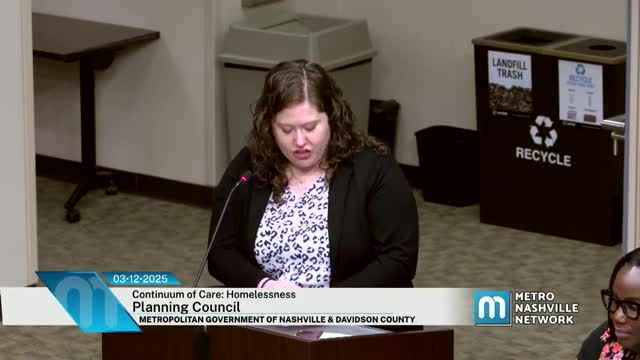
Summary
Allison Cantway reported Nashville received $11.8 million in Continuum of Care awards; OHS is now the collaborative applicant but Metro charter rules limit the ability to pay committee members for participation, complicating payment for lived‑experience roles previously handled by MDHA.
The council heard that the U.S. Department of Housing and Urban Development (HUD) announced Continuum of Care awards and that Nashville received approximately $11,800,000 — the largest CoC award the city has received, according to the collaborative applicant’s report.
Allison Cantway, representing the collaborative applicant functions, said the award was announced in January and that contracts tied to the award had not yet been issued at the time of the meeting. Cantway said staff were meeting with CoC‑funded agencies to build a narrative describing how those dollars are used in Nashville and to prepare for potential federal changes.
Separately, Cantway reported that the collaborative applicant role has formally transferred to the Office of Homeless Services (OHS) following a multi‑year process. She thanked Metropolitan Development and Housing Agency (MDHA) staff for help in the transition. That transfer has operational consequences for how planning funds are used: MDHA previously administered planning funding that supported payments to people with lived experience as a HUD best practice. Cantway said that after the transfer, OHS must follow Metro finance rules and the Metro charter, which generally prohibit paying board members for committee participation; teams sought guidance from legal counsel and HUD on creative approaches but noted the charter constrains direct payment via the board.
Cantway said OHS consulted legal counsel and multiple HUD technical advisers in exploring options but that the Metro Charter’s provisions require “creative solutions” because planning funds are now under Metro finance rules. The meeting packet includes a memorandum that explains the differences in administrative rules and the history of payments under MDHA. Cantway said OHS will continue to seek compliant ways to support lived‑experience participation and will provide updates to the council as options are identified.
Council members asked clarifying questions about the award timeline and the practical effects of the collaborative applicant transfer. Cantway said contracts for CoC awards typically follow HUD’s award notice and that staff were watching the timeline closely.