
City reviews Major Roads Plan, gets GIS 'story map' to guide access management and crash mitigation
Get AI-powered insights, summaries, and transcripts
Subscribe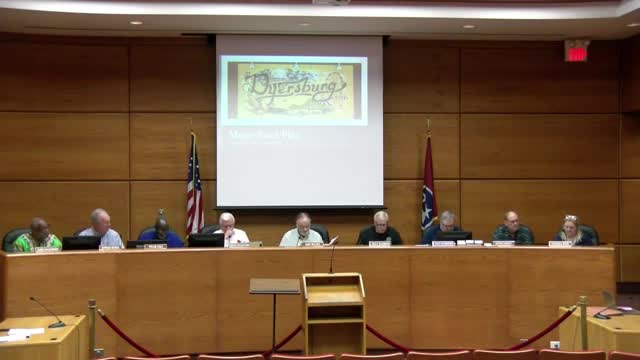
Summary
City officials heard a presentation from WSP on an updated Major Roads Plan funded by a Tennessee Department of Transportation planning grant; the consultant showed a GIS "story map," crash-heat maps and draft access-management recommendations intended to guide future development and signal/warrant requests on state routes.
Dyersburg aldermen on Monday reviewed a draft Major Roads Plan and a digital geographic-information "story map" prepared by WSP under a Tennessee Department of Transportation planning grant.
The presentation, given by Emily Ritzler with WSP, described the plan's purpose as aligning roadway functional classifications with the city's land-use patterns and providing a data-backed tool for development review and grant applications. "We are the consulting team that's been working on on this project," Ritzler said during the short slide presentation.
Ritzler demonstrated an interactive story map that combines roadway classifications, crash data, future land-use layers and other reference maps. She pointed to a heat map of crashes and said the dataset helps identify conflict points where access (driveways and turning movements) likely contributes to collisions. "All of those big yellow areas are where you have the most intensity of crashes," she said, describing how the map can be zoomed to get collision details for specific locations.
The plan includes draft access-management guidance for arterials, collectors and local streets: recommended limits on the number and spacing of driveways, corner clearance distances and, in some commercial corridors, consideration of frontage roads to consolidate access. Ritzler said those recommendations are based on industry standards and comparable cities and can be carried into a formal ordinance if the council chooses.
In response to council questions, Ritzler said the story map and its underlying database will be turned over to the city for internal use or public posting on the city's GIS portal. She also said the plan will help the city assemble the data needed when requesting traffic signals or other changes on state-controlled roads. "It would give you the information and data to help provide the information to them when you're making a request," she said about requests to the Tennessee Department of Transportation.
Council members and attendees raised specific local concerns: the intersection at Pinto Lane near Kroger and the portion of Lake Road between the bypass and Mall Boulevard were identified as areas with both heavy traffic and high crash concentration on the map. Ritzler agreed to review those points and follow up with city staff so the council could evaluate options, including travel-demand data, alternative access patterns and traffic-calming design elements.
Ritzler summarized traffic-calming measures that can be used on narrower neighborhood streets or commercial corridors, including striping, curb bulb-outs, medians and pilotable planter-based features. She said these design changes, combined with access-management adjustments on major corridors, can reduce conflict points and slow speeds without relying solely on enforcement.
The plan is a draft; Ritzler said she will finalize recommendations after internal edits and provide the full package and GIS files to the city. Council members said the plan will be useful for upcoming development reviews and grant applications.
The council did not take a formal vote on the Major Roads Plan at the meeting; the presentation served as the council's first full review of the draft and the story map.