Homelessness Planning Council approves updated HMIS policies, user agreements
March 22, 2025 | Homelessness Planning Council Meetings, Nashville, Davidson County, Tennessee
This article was created by AI summarizing key points discussed. AI makes mistakes, so for full details and context, please refer to the video of the full meeting. Please report any errors so we can fix them. Report an error »
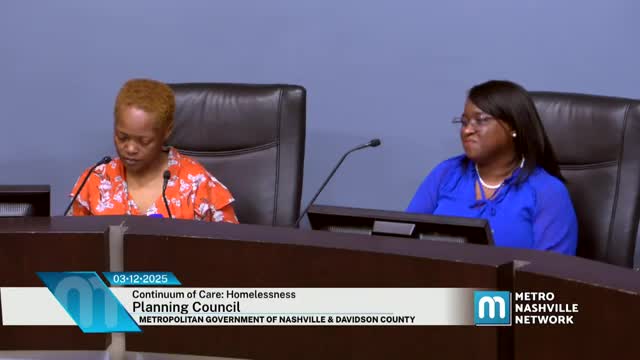
Shanley Degnan, chair of the HMIS Oversight and Data Committee, summarized the recommended changes, saying the revisions largely reflect the current scale of HMIS participation and “shift in responsibility” for training and vetting to participating agencies. Degnan described three attached documents that will accompany the manual: an end‑user agreement, a primary point‑of‑contact agreement and a participating‑agency agreement. She said each of those documents now includes language that the recommended HMIS users must not have identity‑theft or stalking‑related felony convictions and that agencies must verify that fact before recommending access.
The manual also clarifies monitoring and enforcement. Hannah (HMIS data lead) said the draft currently categorizes violations as minor, major and severe and labels privacy and security violations as severe: “security violations such as recommending a user who should not have access, would be a severe violation.” Council members asked how enforcement would work and whether entire agencies could lose access; Degnan and Hannah said agencies could be held accountable and that users and clients retain grievance paths to the HMIS lead, the oversight body or HUD.
Council members moved to approve the HMIS policies and procedures manual and to include the three attached documents (the participating agency agreement, the primary point of contact agreement and the end‑user agreement). The chair called for the vote; members indicated support by voice/raised hand. The chair announced the motion passed.
The revisions were introduced in discussion sections identified by the committee as section 4.1 (user access) in the policies and on page 3, item e, of the participating agency agreement, per committee references during the presentation. Committee members said those specific references are intended to make clearer which pages contain the new access and verification language.
Degnan also emphasized the practical reason for the change: HMIS has grown from under 20 participating agencies and fewer than 100 users to roughly 40–50 agencies and several hundred users, prompting a reallocation of operational responsibilities to local participating organizations.
The council approved the manual and attached documents to move the update into effect and to allow the HMIS lead and participating agencies to implement the new verification processes and monitoring steps described in the documents.
Notes: The formal vote was taken by voice/raised hands; no opposing votes were recorded on the transcript. The packet references specific pages for the language changes (policies and procedures manual, section 4.1, page 9; participating agency agreement, page 3, item e).
Don't Miss a Word: See the Full Meeting!
Go beyond summaries. Unlock every video, transcript, and key insight with a Founder Membership.
30-day money-back guarantee
Sponsors
Proudly supported by sponsors who keep Tennessee articles free in 2026

