
Planning Commission studies Phase 2 development-code amendments covering neighborhood retail, FAR, lot coverage and parking
Get AI-powered insights, summaries, and transcripts
Subscribe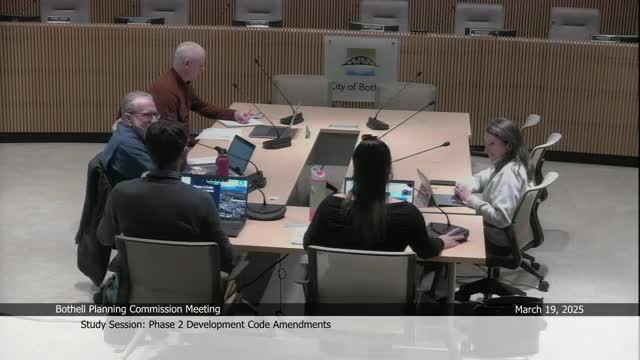
Summary
Staff presented Phase 2 development-code topics March 19 including neighborhood-scale commercial rules, a review of floor-area-ratio (FAR), lot-coverage consolidation, parking changes tied to state bill SB 5184, variance criteria and docketing process; commissioners provided feedback but no formal action was taken.
City of Bothell planners presented a study session March 19 on Phase 2 development-code amendments, covering neighborhood‑scale commercial standards, floor‑area‑ratio (FAR), lot coverage, parking regulation changes tied to pending state legislation (Senate Bill 5184), variance criteria and the private amendment (docket) process. No formal action was taken; staff requested commissioner feedback to guide draft code language.
Planner Jacqueline Simpson (presenting) summarized staff recommendations and examples from other jurisdictions. On neighborhood‑scale commercial, Simpson read the working definition used by staff: "neighborhood scale commercial means small scale retail service and office uses that primarily serve the daily needs of nearby residents by providing essential goods, professional and personal services, and neighboring gathering places." Staff recommended limiting outdoor storage and vehicle storage, setting hours (permits and deliveries) generally to 6 a.m.–10 p.m. weekdays and 7 a.m.–10 p.m. weekends, and scaling commercial area to 30 percent of lot size up to a 3,500‑square‑foot maximum (approach adapted from other Washington cities and Department of Commerce guidance).
Commissioners raised implementation questions. Commissioner Gustafson asked whether healthcare uses such as pharmacies or small urgent‑care clinics could be included; Simpson said pharmacies are included in the Commerce guidelines and could be added. Commissioners discussed whether professional offices should be allowed on the ground floor versus upper floors and whether the intent statement should guide decisions on uses not specifically listed.
On FAR, staff explained FAR is the ratio of total building floor area to lot area and said removing FAR would require updating the comprehensive plan, housing and transportation policies and a supplemental EIS because current capacity assumptions in the city’s plans use existing FAR limits. Staff recommended deferring any removal of maximum FAR to a future work plan so the environmental and infrastructure implications can be fully evaluated.
Lot coverage discussion noted the city currently calculates separate maximums for building coverage and hard/impervious surface. Staff recommended pausing removal of lot‑coverage regulations until the urban forestry management plan (UFMP) and final parking standards are completed, but suggested consolidating building coverage and hard surface coverage into a single hard‑surface coverage calculation to simplify the code. Staff said the UFMP data and policies are expected to advance through the summer, with fuller deliberations by year‑end.
On parking, staff reviewed the current draft alignment with Senate Bill 5184 (state bill under consideration). The draft would consolidate commercial parking into one category at 1 space per 1,000 square feet, set a residential base standard at 0.5 stalls per unit (all unit sizes), remove guest parking requirements and provide exemptions for affordable housing, senior housing and certain other uses. Staff described this draft as a proactive alignment with the current form of the state bill and said the city could implement changes quickly if the law is adopted. Commissioners generally supported the proactive approach; several urged staff to track bicycle parking, EV and ADA requirements which were not changed in the draft.
Staff also said they will review variance criteria (noting the current bar for a variance is high and the city uses other administrative deviations already) and will propose clearer rules for private amendment requests so applicants and decision makers have consistent expectations. Simpson said staff aims to return with drafted code language on neighborhood‑scale commercial and proposed lot‑coverage consolidation at the next meeting.
Ending The commission provided direction and feedback but took no formal votes on Phase 2 topics. Staff will prepare draft code language and return to the Planning Commission for additional review.