Board directs feasibility study after code review flags multiple issues at Greenwich High School pool
Summary
After an independent facilities review identified multiple code and infrastructure issues at the Greenwich High School natatorium, the Board of Education signaled unanimous support for a feasibility study and for keeping the pool open while the work proceeds.
The Greenwich Board of Education on an unan‑imous “sense of the meeting” directed staff to launch a feasibility study of the Greenwich High School (GHS) natatorium and to prioritize keeping the pool operational while planners evaluate repair and replacement options.
The move followed a presentation by architect Mike Fortuna and facilities staff summarizing a technical report that identified several code and infrastructure shortcomings — including clogged drain piping connected with compliance concerns under the Virginia Graeme Baker (VGB) federal law for pool drains, piping and turnover-rate issues, overhead clearance shortfalls at the diving board, deteriorating filter tanks and electrical clearance problems.
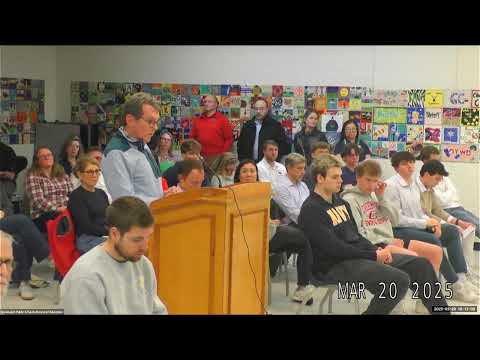
Board members, coaches, students and parents told the board the pool is heavily used year‑round by GHS swim, dive and water‑polo teams, the Greenwich Dolphins club, and community groups, and urged solutions that avoid a long shutdown. Several speakers asked for a special advisory group to examine options and funding.
Why it matters: The report framed the problem as a mix of safety and code compliance items (drains and diving‑board clearances) and operational/maintenance items (deck finishes, filter tanks, backwash routing). The VGB standard for suction outlet systems and the state and local health/building codes set prescriptive requirements; the report said parts of the existing system no longer meet today’s configurations and that making piecemeal fixes without addressing related piping or structural issues could lead to further failures.
Key details from the report and conversation: - The consultant told the board three of the natatorium’s four main drain lines are clogged, leaving most flow to a single drain; that raises VGB compliance concerns and would likely require reconfiguration of piping and larger-diameter lines to meet turnover and velocity limits. - The report said the diving board area does not meet the adopted overhead clearance standard (about 16 feet, 5 inches measured from the board tip under current NCAA‑derived guidance adopted in state regulations); the consultant said raising roof structure or building a new diving facility would be among the options. - The pool shell dates to the 1960s with an extensive 1997 renovation that deepened the pool; the consultant said the concrete and ground/groundwater conditions warrant further testing (chloride testing and cores) before deciding whether to rebuild on the existing shell or construct a new facility. - The filter plant includes 480V electrical equipment with insufficient working clearance per the National Electrical Code and filter tanks that are deteriorating and should be replaced; the report also notes that current filter backwash is routed to an outfall and should be diverted to sanitary sewer per code.
Public comments and stakeholder input: More than a dozen students, parents, coaches and town volunteers spoke during public comment. Speakers included GHS students who described the pool’s role in daily practice and hosting meets; long‑time coach Terry Lowe emphasized decades of program experience and asked that coaches be consulted; parents and RTM members urged a special committee and proposed limiting any shutdown to summer months, if possible.
Board response and next steps: Board members said they want a feasibility study that will (a) test the existing pool shell and materials, (b) quantify repair versus replacement costs and schedules, (c) identify interim options to avoid a September–June shutdown, and (d) define stakeholder engagement and funding pathways. The board recorded a unanimous sense of the meeting in favor of forming such a feasibility effort and keeping the pool open while the study proceeds.
What the study will examine: technical testing of the pool shell and piping; options to remedy suction/outlet configurations to meet VGB requirements; alternatives for diving‑board clearance; filter plant and electrical upgrades; deck/bleacher and ADA questions; schedule options for phased work or new construction, and funding sources.
The board did not adopt a formal capital authorization at this meeting; the discussion was limited to directing a feasibility analysis and further study.
AI generated
The text on this page is AI generated. Summaries, highlights, analysis, and video transcripts are all produced from the original source material.
AI can make mistakes, so if you spot one, and we will fix it for everyone.
Note: the source content is unaltered by us. Any content source we link to, be it a video, an audio recording, or a document, is presented exactly as its publisher released it. That publisher is usually a government body, sometimes an individual official or another organisation.