Get Full Government Meeting Transcripts, Videos, & Alerts Forever!
Get email alerts on the Wastewater Sewage Management topic
No spam. Unsubscribe anytime.
Hamilton County Commission approves resolution directing on‑site wastewater systems to WWTA standards
Summary
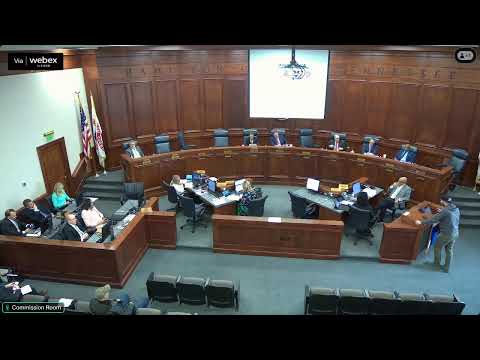
After hours of debate and public comment, the Hamilton County Commission on March 3 approved Resolution 3-25-17, directing on‑site wastewater treatment facilities be built to standards set by the Hamilton County Water and Wastewater Treatment Authority and transferred to that authority for ownership and operation.
The Hamilton County Commission voted March 3 to require on‑site wastewater treatment facilities in the county be constructed to standards set by the Hamilton County Water and Wastewater Treatment Authority and transferred to that authority for ownership and operation.
The resolution, filed as 3-25-17, passed on a roll-call vote after several commissioners urged the authority be given operational control, while others urged delay until the authority and state regulators finish drafting new rules.
Supporters argued local, long‑term oversight is needed to prevent design, installation and operational failures. Gary Bowles, a resident and engineer who spoke during public comment, said the county created the authority in 1993 “to protect the environment and the public by regulating the quality of water discharged into wastewater collection systems and treatment works.” Builder and developer Ryan Glasscock described past problems in nearby counties and told commissioners, “We’re confident the WWTA will do a much better and safer job running these systems than a for profit LLC.”
Opponents and some commissioners said they supported the idea in principle but worried the county should wait for the authority’s updated regulations before formally ceding oversight. “I kind of feel as though this particular resolution is kind of putting the cart before the horse, so to speak,” Commissioner Sharp said, urging a deferral until the Water and Wastewater Treatment Authority (WWTA) adopts its new rules.
Mike Patrick, identified in the meeting as director of the WWTA, told the commission the authority has been “studying a change in our current regulations for approximately the last six months. Potentially, they could be passed in April at the April board meeting.” That timetable prompted some commissioners to ask for a deferral with a target date; a motion to defer failed on a roll call and the commission ultimately approved the resolution.
Commissioner Baker, who moved approval of the resolution, said the change would help manage growth and protect neighborhoods and groundwater. “I urge everyone to please support this resolution,” he said.
Public commenters from across the county—homebuilders, retired engineers and neighborhood residents—offered mixed perspectives. Julian Bell, speaking for the Homebuilder Association of Greater Chattanooga, said builders supported a short deferral to allow WWTA to finish drafting rules and for the commission to see them. Others, including Tommy Farmer and Kathy Faulkner, urged prompt action to ensure local, accountable management of decentralized systems.
The commission’s action does not itself create the authority’s technical standards; it authorizes that WWTA standards will govern construction and that completed systems be transferred for WWTA ownership and operation. Commissioners and WWTA staff said subsequent WWTA regulations and any state law changes could affect implementation.
The debate referenced pending state legislation (identified in the meeting as Senate Bill 564 and House Bill 803) that would permit developers to build and operate private wastewater systems; speakers said the possibility of state preemption was a factor in the timing and urgency of local action.
What happens next: the WWTA must finalize its regulations and then oversee construction and transfer of on‑site systems under the county resolution. Several commissioners asked WWTA to return with its adopted rules for the commission’s review; WWTA staff said they expected to vote on new rules in April but provided no guaranteed date for submission to the commission.
Votes at a glance - Resolution 3-25-17 (require on‑site wastewater facilities be constructed to WWTA standards and transferred to WWTA): Approved on roll call (11 yes, 0 no). Motion to defer earlier in the meeting failed on a roll call. (See Actions below for details.) - Other items of note: the commission later moved several consent and routine resolutions (including a short deferral of resolution 3-25-36, see Actions), and approved opioid‑settlement funding allocations (resolution 3-25-37). Those items were acted on in separate votes and are summarized in the Actions list below.
Ending: The resolution commits the county to local oversight through the WWTA while leaving technical rulemaking to that authority; commissioners agreed the next substantive step is for WWTA to finalize and present its updated regulations so the commission and the public can review implementation details.