
Worcester County adopts Dynamic Impact school‑improvement cycle to strengthen adult practices and student outcomes
Get AI-powered insights, summaries, and transcripts
Subscribe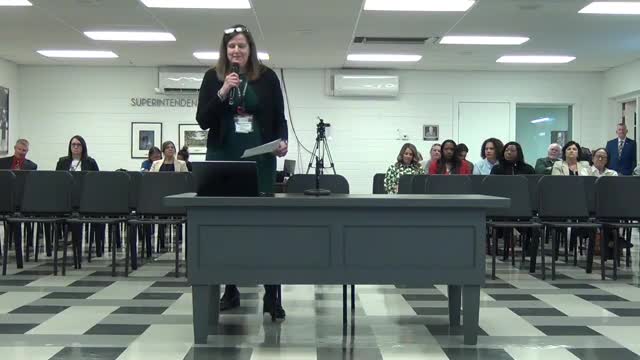
Summary
District staff described a countywide Dynamic Impact process that focuses school teams on adult collaboration, data-driven root‑cause analysis and iterative action cycles to raise student achievement.
Kirsten Savage, the district’s school improvement coordinator, told the Worcester County Board of Education that schools are using the Dynamic Impact process to focus teams on adult practices that drive student outcomes. Savage described three school teams — safety (attendance and behavior), and two academic teams (literacy and mathematics) — that meet monthly and follow the TAP IT cycle: Team, Analyze, Plan, Implement, and Track.
“Sustained focus on adult teaming and collective efficacy is the driver of improved student performance,” Savage said, explaining that teams craft a vision, complete a high‑performance team rating, analyze student data with a root‑cause triangle, plan evidence‑based adult actions, implement professional learning and then review outcomes at midcycle and semester endpoints.
Savage said one school used the root‑cause triangle to determine that math interventions were not translating into success in grade‑level instruction. The team adopted a math‑planning practice that emphasized scaffolding and differentiation during the main lesson, paired with targeted professional development on math progressions. The team then monitored student and implementation data and adjusted steps when goals were not met.
Board members asked about scope and cadence. Savage said the approach covers elementary through high school, teams meet monthly with a summer kickoff and midcycle checkpoints, and membership typically includes general‑education teachers, special‑education and multilingual staff, counselors and administrators.
Board member Bill Gordy praised the approach and credited staff for producing measurable results. Superintendent Louis H. Taylor and other board members noted the district has used outside partners previously (Johns Hopkins University) and transitioned to local leadership using ESSER funding for implementation support in recent years.
Savage said the district emphasizes “collective efficacy” — staff’s shared belief that coordinated adult action will improve outcomes — and cited education research showing collective efficacy strongly correlates with student gains. She said teams celebrate progress and make data‑driven adjustments when plans fall short.