Get Full Government Meeting Transcripts, Videos, & Alerts Forever!
Get email alerts on the Budget topic
No spam. Unsubscribe anytime.
Medford School Committee proposes roughly $4.5 million FY26 budget increase, flags staffing and maintenance needs
Summary
Budget analyst Gerald McHugh presented a draft FY26 budget request that would raise Medford Public Schools spending about $4.5 million (5.5%), citing contract step increases, special-education costs, software and cybersecurity needs, deferred maintenance and staffing requests held pending schedule and grant clarity.
Gerald McHugh, the district's budget analyst, told the Medford School Committee on March 20 that the school department is proposing a draft fiscal year 2026 budget that would increase spending by about $4,500,000, or 5.5% over FY25.
McHugh said the request reflects several categories of unavoidable changes, including contract step increases, adjustments to special-education transportation and tuition, and funding shifts for software and food-service rules. "We are not contemplating any across the board staffing cuts that were necessary to balance the FY25 budget," McHugh said, adding the district is "planning as if we're going to receive the grants we have this year, next year," while closely monitoring federal grant status and awaiting DESE guidance.
The budget presentation detailed line-item changes and new requests. Notable proposed increases and adjustments include: an athletic budget increase of $32,500 to account for current team activity and contracted services; funding for three 1-on-1 paraprofessionals required by students' IEPs; moving lunch monitor positions from the lunch fund to the general fund to meet food-service regulations; and adding costs for two instructional software products (ST Math and MAP Assessment) that lost grant eligibility. McHugh also listed roughly $800,000 of instructional and administrative software and cybersecurity costs that the district seeks to fully fund in FY26.
Facilities and maintenance needs are a major component of the request. McHugh said the committee proposes a roughly $457,000 increase to maintenance-related lines, including a $330,000 boost for extraordinary maintenance and capital-like repairs. He cited failing air-conditioning units in technology rooms and the likely need to replace a fire-alarm panel at a school (school name not specified in the transcript) as examples of urgent capital items.
On safety and operations, the district proposes funding to cover 14 security monitors districtwide after discovering FY25 had been underbudgeted for monitor positions and after adding a night-shift monitor during the year. The budget also includes a proposed new information-technology structure: a director of network and technology services, a network technician, and funding to replace end-of-life network equipment.
Special-education costs drove other increases. McHugh said FY25 transportation contract rate increases raised transportation spending by roughly $557,000; the FY25 tuition budget was about $5.5 million and state tuition rates were increased 3.87%. The district plans to rely on a mix of general fund, IDEA grant funds (about $850,000), and circuit breaker reimbursements to cover projected FY26 special-education tuition and transportation needs. McHugh said he expects circuit breaker funds will cover roughly $1.6 million in tuition and $557,000 in transportation, with some carryover remaining.
The presentation also flagged program-level requests: City Year services at two schools (about $100,000 per school, with a portion charged to before/after-care), a $12,000 allocation for Project Transition (an 18-to-22 program), $53,000 for extended-year special-education slots, and a $30,000 general-fund contribution to summer school to reduce a revolving-fund deficit. Smaller increases include $2,000 requests each for guidance and world-language assessment expansions.
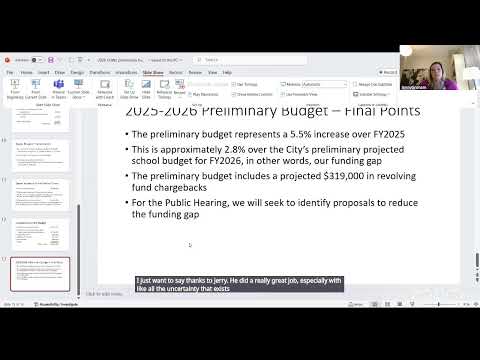
McHugh said the total request ($4.5 million, a 5.5% rise) is about 2.8 percentage points higher than the city's preliminary projected school allocation, and he said the district will pursue several options before the public hearing to narrow the gap, including drawing on revolving funds, ensuring grant-funded positions are coded to grants and, potentially, using leftover Question 8 voter-approved funds. "I think we can anticipate using Question 8 funds in '26 to help with those collective bargaining agreements," McHugh said, but he cautioned the timing and amount available will depend on settlement details and when payments are made.
School Committee member Mima Graham framed the March 24 public hearing as the district's formal request to the municipal budget process and reminded the public that the committee will later reconcile its request with the mayor's and council's actions. "This is our request," Graham said. She described the FY26 request as consistent with Chapter 70 projections and emphasized uncertainty created by active collective-bargaining negotiations: "Without clarity on that just yet, there's a lot of uncertainty that between now and June ... will come into focus."
McHugh and committee members said staff will work over the coming days to identify resources and adjustments to reduce the difference between the request and the city's projection before the public hearing. The committee took no further budget votes at the meeting and adjourned after the presentation.