Get Full Government Meeting Transcripts, Videos, & Alerts Forever!
Get email alerts on the Zoning Code topic
No spam. Unsubscribe anytime.
Committee hears 28-page zoning rewrite, holds bill for one week to refine amendments
Summary
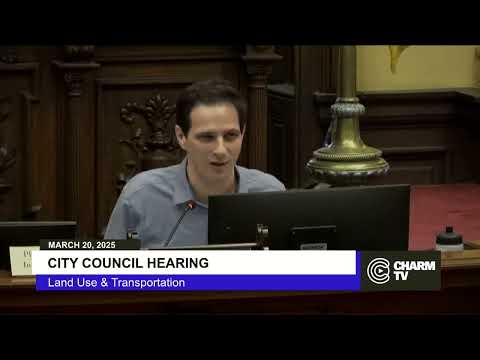
The Baltimore City Land Use and Transportation Committee, chaired by Councilman Ryan Dorsey, spent a hearing reviewing Council Bill 2500006, a 28‑page package of zoning code modifications that the committee described as roughly 30 separate changes and two dozen amendments. Committee members continued the matter for one week and set a voting session for Thursday, March 27 at 10 a.m.
The Baltimore City Land Use and Transportation Committee, chaired by Councilman Ryan Dorsey, spent a hearing reviewing Council Bill 2500006, a 28‑page package of zoning code modifications that the committee described as roughly 30 separate changes and two dozen amendments. Committee members continued the matter for one week and set a voting session for Thursday, March 27 at 10 a.m.
The bill is an administration bill from the Planning Department and carries amendments from planning staff and several council members; committee staff described the text as a mix of corrective edits and substantive policy changes. Jeff Hockstetler of the City Solicitor’s Office told the committee that law "could approve the bill with a minor amendment," and the Board of Municipal and Zoning Appeals and the Department of Housing and Community Development each presented favorable reports. Becky Witt of BMZA said the board had submitted a favorable report, and Jason Wright of the Department of Housing and Community Development said his department “stand[s] behind our favorable bill report.”
Why it matters: The package changes multiple parts of the code that affect how neighborhoods are reviewed and how routine projects move through permitting and appeals. Committee members and agency representatives said the changes aim to correct legacy drafting errors, update procedures for modern notice practices and clarify where planning and design review apply, while some council members and the mayor’s office urged more outreach on particular amendments.
Key elements explained
- Codifying tables and correcting drafting errors: The bill clarifies that certain use tables are codified (not merely explanatory), fixes typos and restores omitted references to the City Council in sections authorizing variance grants. Councilman Dorsey said the change corrects a "holdover provision" left from the prior code.
- Planning commission duties and rezoning cadence: The Planning Department moved language that previously read as a mandatory annual comprehensive rezoning to a less prescriptive formulation. Eric Tissot of the Planning Commission explained the change is intended to allow a periodic comprehensive rezoning process "from time to time" and to enable an annual window or grouped handling of piecemeal rezoning requests rather than forcing a reading that the city must rezone all parcels every year.
- Design review, accessory dwelling units and multiple principal structures: The package adds site‑plan and design‑review triggers for applications that would create multiple principal structures on a lot and opens discussion on accessory dwelling units (ADUs). Dorsey said the changes "softly open the door" to wider consideration of ADUs while additional standards remain to be drafted.
- Variances and BMZA standards: Draft language refines variance approval standards (substituting "peculiar" for "unique" and adding a practical‑difficulty focus), clarifies that variances cannot be used to authorize uses not allowed in a zone, and explicitly lists decisionmakers (zoning administrator, BMZA, City Council). Becky Witt said the code edits borrow standards used elsewhere and remove an unused "unnecessary hardship" standard.
- Procedural clarifications: The bill increases the lapse period for variances and conditional uses from one year to two years, aligns posting periods (minor variance posting from 10 to 21 days), modernizes mailed and posted notice requirements and adds language requiring an applicant affidavit in the statement of intent for private‑interest zoning bills.
- Nonconforming structures and conversions: The draft restores explicit language allowing variances for certain expansions of nonconforming structures and revises how legally converted multifamily units are treated when properties sit vacant, a change proponents said would speed rehabs and reoccupations.
Debate and outstanding items
Several council members pushed for narrower drafting on specific amendments. Councilmembers Odette Ramos and Germaine Jones presented an amendment to require City Council review by ordinance for certain large utility facilities in industrial districts (I‑1 and I‑2); Planning staff and the mayor’s office asked for narrower language and outreach because the code definition of "utilities" includes many uses (natural gas, power lines, alternative energy systems, fiber optic lines, and more). Tyler Schnell of the Mayor’s Office of Government Relations said he was not prepared to accept that amendment as friendly without consultation.
A proposed amendment from Councilman Dorsey would exempt up to three dwelling units from off‑street parking requirements to ease small conversions and infill housing; several colleagues requested more time and public notice before adopting that change citywide.
Next steps and procedural direction
Dorsey asked sponsors and planning staff to redraft and circulate changes; several speakers asked for written amendments rather than oral revisions. The committee held the bill for one week and scheduled a combined hearing and voting session for Thursday, March 27 at 10 a.m. to receive revised and corrected amendments and to vote.
Ending
Committee members, agency staff and bill sponsors agreed to continue work on targeted clarifications and to use the week ahead to reconcile the mayor’s office, planning and council concerns before the scheduled voting session.