
Appellate panel hears claim that poor legal advice led Charles Hardy Jr. to waive right to testify
Get AI-powered insights, summaries, and transcripts
Subscribe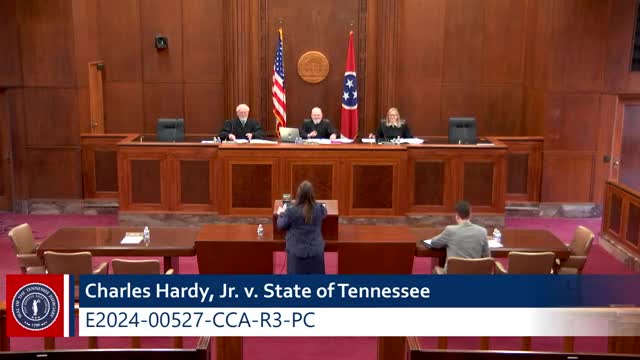
Summary
At an appellate oral argument in Knoxville, counsel for Charles Hardy Jr. argued that trial counsel’s advice led Hardy to waive his right to testify, depriving the jury of his explanation of a police statement; the State countered that the record shows admissions to police and no evidence of prejudice. No decision was announced.
At an appellate oral argument in Knoxville, Chelsea Moore, counsel for appellant Charles Hardy Jr., told the court that Hardy was “misunderstood, shut down, and ultimately denied” the chance to explain a police interview because of erroneous legal advice from his trial attorney.
The argument centers on whether trial counsel’s advice that Hardy should not testify was unreasonable and therefore rendered Hardy’s waiver of testimony not knowing and voluntary. If the panel finds counsel ineffective and prejudice, Hardy’s conviction for first-degree murder could be reconsidered.
Moore said trial counsel never allowed Hardy to explain a recorded police interview in which, she said, Hardy intended only to describe beating the victim in defense of his girlfriend and to boast of knife skills, not to confess to a fatal stabbing. “This case is about a man who wanted to tell a story but was misunderstood, shut down, and ultimately denied,” Moore said. She told the court that, had Hardy testified at trial, he would have been able to explain the interview and the jury would have heard an alternate account of events.
Moore emphasized that the autopsy and the state’s theory diverged; she described the autopsy as showing many superficial sharp-force injuries and a single fatal stab wound the State called a later, separate attack. She also argued trial counsel failed to adapt strategy when the State’s witnesses suggested a second, fatal stabbing and that counsel’s decision not to retain a medical expert and not to let Hardy testify was unreasonable. Moore added that Rule 13 funding limits for indigent post-conviction counsel hampered presenting expert evidence of prejudice.
Johnny Saracena, who argued for the State, urged the panel to defer to the post-conviction court’s findings that trial counsel was credible and Hardy was not. Saracena summarized the trial evidence: according to the State, the victim, identified in the record as Mr. Dickinson, suffered dozens of sharp-force wounds and other blunt-force injuries; the apartment carpet was heavily bloodstained when police arrived; and, Saracena said, the court’s prior opinion noted that the petitioner “admitted to stabbing the victim.” Saracena argued trial counsel developed a reasonable defense strategy — defense of a third party or voluntary manslaughter — and that counsel’s decisions (including not calling an expert) were strategic and do not satisfy the standard for ineffective assistance. He also said the appellant had not shown prejudice linked to any deficiency.
The panel questioned whether appellate courts can overturn a post-conviction finding that credited trial counsel’s testimony over the petitioner’s. Moore urged the court to read the testimonial record for consistencies showing Hardy repeatedly sought to testify and that, she said, he relied on erroneous legal advice when he declined to testify at the Momon colloquy. In rebuttal, Moore reiterated that the substantial prejudice was that Hardy’s version “was not heard or considered by the jury” and that jurors therefore lacked an individualized chance to weigh conflicting accounts.
During argument the State noted details from the trial record: the victim was discovered in an apartment in Knoxville after an extended interval (the State said the victim remained from the early morning when the initial beating occurred until police arrived later the week), witnesses described multiple and severe wounds, and testimony included claims that the petitioner had sought assistance in hiding the body. Defense counsel pointed to the record’s ambiguities about timing and the nature of some wounds and said those ambiguities were exactly what Hardy would have addressed by testifying.
The court did not announce a decision at the hearing. The panel proceeded to its next case after oral argument concluded.