Get Full Government Meeting Transcripts, Videos, & Alerts Forever!
Get email alerts on the Water Management topic
No spam. Unsubscribe anytime.
Council presses for clarity on Flat River reservoir operating plan; amends, then continues vote on $55,575 ARPA weed‑abatement resolution
Summary
Councilors pressed state and engineer testimony on how and when to restore Flat River Reservoir’s water level and unanimously amended, then continued action on a proposed ARPA allocation to treat invasive weeds across four town lakes.
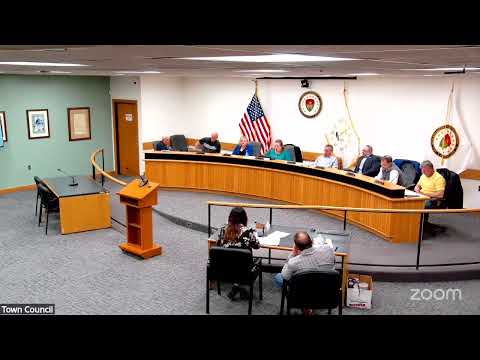
The Coventry Town Council spent substantial time on March 11 on operations at Flat River Reservoir (also called Johnson’s Pond) and on town funding for invasive‑weed treatment across four lakes. The meeting combined technical testimony from engineers and state officials, questions from councilors and residents, and a contentious vote on a proposed ARPA allocation for herbicide treatments.
Permit and water‑level dispute: Council members, engineers and residents debated the reservoir’s operating plan and whether the town should follow historical filling patterns or the water‑level schedule in a 1994–95 lease and subsequent DEM guidance. Bill Ladd, an engineer from GZA who joined by Zoom, summarized the permit’s seasonal water‑level bands and tied those levels to minimum downstream flow rates: an April operating band between 12 and 24 inches below the spillway crest depends on roughly 215 cubic feet per second (CFS) at the downstream gauge; May operations are tied to 150 CFS and June allow raising to crest with a 40 CFS minimum, subject to drought or low flows.
Residents and some council members urged the town to restore earlier, higher spring drawup practice. “We would start to raise this water in late March. It would be close to full in April, and it undoubtedly would be full for May 1. We would not begin rising at May 1,” Councilman Pasqua said, reflecting data assembled by local lake advocates. Pasqua and residents argued DEM’s cited flow floors and the lease language did not match historical practice and that the town should press DEM for a schedule aligned with historical filling to protect public use and local ecosystems.
DEM, lease and data: Town staff and the GZA engineer said the draft operating permit he had reviewed generally carried forward the historic levels established by a 1994–95 consent agreement and lease, as interpreted by DEM’s review of historic USGS gauging and Quinneck Reservoir records from the 1980s–1990s. Town officials agreed to seek a meeting with DEM staff to reconcile the town and residents’ datasets and the draft permit language: the council directed staff and the engineers to request a follow‑up meeting with DEM and to bring historical data to ensure all parties are reviewing the same records.
Weed‑management funding and ARPA resolution: Councilors discussed resolution 2025‑08, a one‑time plan to spend federal ARPA funds on aquatic invasive‑weed treatment for Flat River Reservoir and three other public water bodies: Upper Dam Pond, Bridal Dam and Tioga Lake. Sponsors originally proposed allocating $35,000 for Flat River Reservoir, $8,925 for Upper Dam Pond, $6,650 for Bridal Dam and $5,000 for Tioga Lake (total $55,575). Tom Pendergast, speaking for the Upper Dam Pond Conservation Association, told the council his group recommended supporting the resolution and would set aside matching funds for stormwater work tied to lake health. Jerry Norkowitz cited treatment estimates from contractors and told the council his analysis suggested more than $44,000 would be needed to adequately treat the four water bodies.
Amendment and outcome: Councilman Brown proposed amending the Tioga Lake allocation upward by $4,600 to match association requests; the council approved the amendment unanimously. Council members debated whether use of ARPA funds was allowable; Solicitor Angel said the town could use ARPA to cover an identified deficit so long as the specific MOU/open‑space ARPA line item permitted that use, but he recommended the council confirm the eligibility in writing. Rather than vote final appropriation that night, the council voted unanimously to continue the amended resolution to the March 11 agenda so staff could confirm an acceptable ARPA line item or alternative funding pathway. Officials said the follow‑up would include a fiscal note and, if necessary, an alternative funding resolution to avoid delays to permitting and treatment.
Why this matters: Residents said weed growth has already affected public beaches, boating and dissolved oxygen in some ponds; local associations stressed year‑to‑year treatment is expensive and that delayed spring application can raise costs and limit effectiveness. Council members said they wanted to be careful to follow federal ARPA rules and to preserve municipal fiscal controls while also supporting lake health.
Ending: The council directed staff to confirm ARPA eligibility and to meet with DEM and engineers to reconcile historical data and the draft permit. The amended, $60,001 total (after the $4,600 Tioga increase) resolution will return to the council’s March 11 agenda for final action.