
House discussion: proposal would expand Joint Fiscal Committee and Emergency Board authority to respond to federal funding cuts
Get AI-powered insights, summaries, and transcripts
Subscribe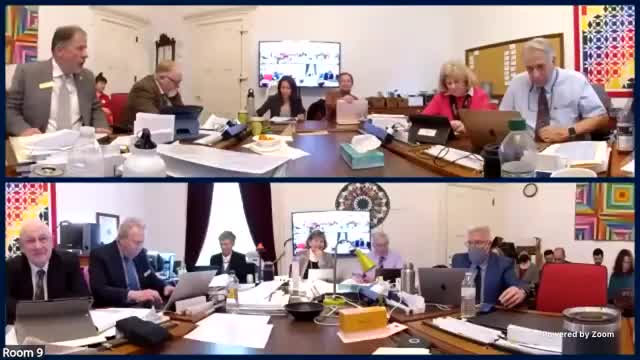
Summary
BRATTLEBORO — The House Appropriations Committee on March 21 heard a proposal to broaden the interim authority of the Joint Fiscal Committee and the Emergency Board to respond when federal funding or state revenue projections fall short.
BRATTLEBORO — The House Appropriations Committee on March 21 heard a proposal to broaden the interim authority of the Joint Fiscal Committee and the Emergency Board to respond when federal funding or state revenue projections fall short.
Representative Emily Kornhauser, chair of the Joint Fiscal Committee and a representative from Brattleboro, told the committee that the change is aimed at giving the Legislature a clearer, more flexible tool to protect priorities during sudden changes in federal funding. "I think you all know probably more than most folks in this building, the tremendous fiscal instability that we are operating in right now," Kornhauser said. She said the package includes a legislative-intent session law, changes to existing rescission authority, and revisions to the state reserve rules.
The draft would add a trigger to the statute that governs rescission-plan authority to allow the JFC to act if a reduction in federal funds results in a 1% or greater decrease in the total funds available to support an appropriation. "So this provides just as you said, in any instance where the reduction in federal funds has the result of reducing in a 1% or more reduction in the total funds available, to support an appropriation," Kornhauser said.
Under the proposal, when that trigger occurs the Secretary of Administration would prepare an expenditure-reduction plan for approval by the Joint Fiscal Committee. The JFC may then recommend actions to the Emergency Board, including drawing on the general fund balance reserve (the "rainy day" fund) to support impacted programs no more than the current fiscal-year funding level until the General Assembly reconvenes; reverting unexpended or unobligated funds or abolishing spending authority; or recommending reductions and appropriations necessary to support legislative priorities. The draft caps recommended reductions at no more than 10% of any fund or appropriation.
The bill language would also expand the Emergency Board’s authority to draw on the rainy day fund for expenditures necessitated by unforeseen emergencies, and would raise the statutory target for the general fund balance reserve from 5% to 10% of prior-year general fund appropriations going forward, with the change slated to take effect July 1.
Another provision in the draft would allow the Emergency Board, under specified triggers, to hold agencies harmless or reduce operating burdens by using reserves. The triggers listed are: (1) any declared emergency while the General Assembly is not in session; (2) a reduction in state revenue estimates under existing statute; or (3) a reduction in federal funding meeting the new threshold. The language also prohibits the Emergency Board from providing an agency an amount exceeding the original appropriation set by the General Assembly.
Committee members pressed multiple questions about thresholds and operational details. "Is this required? What triggers this in the first place? Is there a state of emergency that gets called? Is there a state of fiscal emergency that gets called?" asked Tom (committee member). Kornhauser and Legislative Council staff said the statute would not force action — it would authorize a response and require reporting and planning so the Legislature is informed while it is out of session.
Several members said a 1% trigger on reductions was too low for some small agencies and could produce frequent reporting. Committee members used the Department of Labor and the State Library as examples of agencies that rely heavily on federal grants or have small general-fund appropriations; members warned that relatively small absolute changes in those budgets could reach the 1% threshold. Kornhauser said the intent is to track and report small cuts so they do not compound unnoticed while the Legislature is out of session: "we're not going to call us together unless we absolutely must come together, but I think it's important to stay informed."
On the scale of reserves, Emily Burton of the Joint Fiscal Office told the committee the rainy day reserve is projected at about $98,000,000 at the end of fiscal 2025. She said 5% of that is about $5,000,000 and 10% about $10,000,000, figures committee members cited when questioning whether the reserves would be adequate for a large-scale federal reduction.
Legislative Counsel and JFC staff said they had discussed the language with the treasurer’s office and planned to refine it before embedding it in budget bill text. No formal vote or motion was taken in the Appropriations Committee during the presentation; members requested additional drafting detail and signaled willingness to revisit the numeric thresholds if the off-session reporting burden proved excessive.
The committee instructed staff to continue developing the language for inclusion in the fiscal-year bill and to provide clearer reporting mechanics and thresholds before final adoption. Kornhauser said the JFC would monitor the approach during the summer and, if necessary, return to adjust the threshold in the next session.