
Lawyer, board representative say Mount Vernon IDA pilot deals shift school tax burden to local taxpayers
Get AI-powered insights, summaries, and transcripts
Subscribe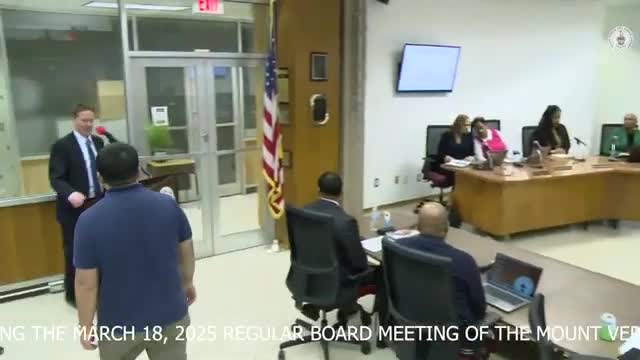
Summary
Mount Vernon legal counsel Tom Scapoli and board representative Chris told trustees that Industrial Development Agency pilot agreements — especially for residential projects — are producing large foregone school tax revenue, leaving the district to educate additional students while receiving far smaller PILOT payments than regular property taxes.
Mount Vernon legal counsel Tom Scapoli and a nonvoting school board representative on the Mount Vernon Industrial Development Agency (IDA) told the school board on March 18 that the IDA’s use of PILOT (payment‑in‑lieu‑of‑tax) agreements for housing projects has created a significant "tax gap" that shifts school funding burdens to other local taxpayers.
Scapoli explained the IDA’s statutory purpose and the mechanics of PILOTs and said the Mount Vernon IDA grants developers exemptions from property, sales and mortgage recording taxes and may negotiate PILOT payments instead. "Pilot is an acronym for a payment in lieu of taxes," he told trustees, and the district has limited legal power to block exemption of school taxes under current state law.
Chris, the school district’s nonvoting representative on the IDA, presented numbers showing how a small set of residential projects produces a meaningful local revenue gap. Using five sample buildings, Chris said the projects house 158 district students; the district’s local cost per pupil (on his calculation) is about $9,381, so educating those students costs roughly $1.48 million annually. The projects’ PILOT payments summed to about $301,000 in 2024, leaving a gap of roughly $1.18 million that local taxpayers must cover. Chris also cited the IDA’s 2022 fiscal data showing the Mount Vernon IDA granted about $6.6 million in tax exemptions and negotiated roughly $2.0 million in PILOTs for a net developer benefit of about $4.5 million for that fiscal year.
Scapoli and Chris said a substantial share of IDA projects in Mount Vernon are residential — Chris said roughly 70% of the IDA’s 2024 projects were housing — and that long PILOT durations (20–30 years, some extended on refinancing) can shift a generation of tax burden away from exempted properties. Chris recommended the board consider a resolution stating the district’s position that school taxes should not be abated without district control, and urged public engagement at IDA hearings and with state legislators. He also reported that, as part of settlement talks stemming from earlier litigation, the IDA agreed to seat one school board member as a nonvoting IDA participant; the district representative receives IDA materials and may attend and speak but has no vote.
Trustees asked whether the IDA projects’ projected student multipliers — the factor used to predict how many students will live in a development — are accurate and whether the district can get better prediction studies. Chris said the district and city have discussed hiring a consultant (Urbanomics was mentioned as an example used by a nearby jurisdiction) to develop a better multiplier; he said the district has pressed the IDA for missing developer application documents and pilot agreements but that some records are not available.
Why it matters: PILOTs reduce the property tax revenue the district would otherwise receive while residential projects can add students, increasing costs. Trustees and the district now have a formal, nonvoting presence on the IDA and must rely on negotiation, public advocacy and, potentially, state legislative changes to alter how exemptions are granted going forward.