
City comptroller: $17.5M tied up in school tax collection; city plans tax‑lien sale
Get AI-powered insights, summaries, and transcripts
Subscribe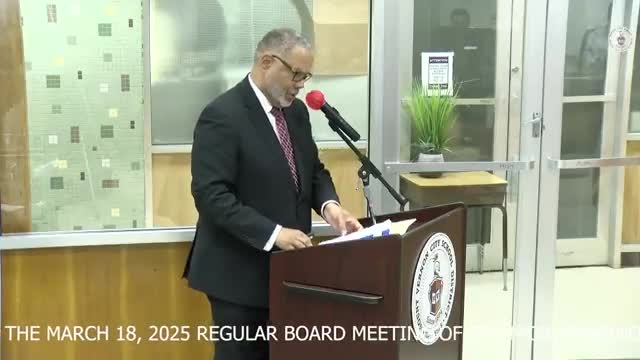
Summary
City Comptroller Darren Morton told the Mount Vernon City School District board on March 18 that roughly $17.5 million in school taxes for 2020–24 remain in active collection and that the city will pursue a tax‑lien sale to recover unpaid amounts; Morton also reviewed an earlier settlement on 2017–19 taxes and said the city has about $3 million left on that prior obligation.
City Comptroller Darren Morton told the Mount Vernon City School District board on March 18 that the city and district are managing large, overdue school tax balances that have strained both organizations’ cash flow and that the city will move toward a tax‑lien sale to accelerate collections.
Morton said the city and district settled a long‑running dispute over unpaid 2017–19 school levies for $11.7 million in principal plus a negotiated 6% interest component of about $2.1 million; the city has paid roughly $10.8 million toward that obligation and the remaining balance is about $3 million under the payment plan, which Morton said is expected to be paid by September 2025. "At the close of that enforcement period ... the comptroller is then to turn over to the treasurer of the school district the principal and the interest that is unpaid," Morton said, describing the statutory handoffs that govern the process.
Morton also laid out the newer set of unpaid taxes that the city is collecting for tax years the district began collecting itself (tax years 2020–2024). He said those years currently total about $17.5 million in the enforcement/collection period — approximately $12.7 million in unpaid tax principal and $4.8 million in interest. Per the timeline Morton described, parts of that total become due to the district on a rolling schedule once the two‑year enforcement period ends: about $7.7 million becomes due in May 2025, roughly $4.2 million will become due in February 2026, and roughly $5.6 million will become due in December 2026. Morton said collectors have already remitted roughly $5 million on those years so far and the remainder remains under active collection.
Morton summarized the statutory process under New York real property tax law: the school district acts as the collecting officer and prepares a certified statement of unpaid taxes at the close of the warrant (the January close), the school board compares and certifies that statement and transmits it to the enforcement officer (the city comptroller), and the enforcement officer then collects for a two‑year enforcement period before turning any remaining unpaid principal and interest over to the school treasurer. He said the collecting officer in Mount Vernon is led by the assistant superintendent for business (referred to in the discussion as Jose) and that the enforcement officer is the city comptroller.
Morton told trustees that because the city lacks the cash flow to "float" large unpaid amounts while foreclosures play out, his office will pursue a tax‑lien sale this year. He said the city historically has used foreclosure but that foreclosure in Mount Vernon is a longer, more litigious path and that a tax‑lien sale can return cash to the city more quickly — even though the lien‑sale route is labor intensive and provides the city less control over buyers. Morton warned the board the lien‑sale process is operationally demanding in Mount Vernon because the city may have nearly 600–700 parcels in arrears and the city charter requires the comptroller or deputies to conduct the auction on specific monthly dates.
Trustees asked about timing and options. Board members pressed whether foreclosure would be preferable; Morton said foreclosure typically takes about two years and requires the city to advance funds while the process runs. He and trustees discussed protections and assistance for seniors, and Morton described recently revised city payment‑plan rules that allow longer terms for low‑income seniors (up to 10 years) and extended residential plans (up to 5 years) with a 10% down payment as a way to reduce the number of parcels heading to auction.
Morton reiterated that the collection timeline — and the district’s certification dates — determines when the city becomes obligated to "make the school whole" under state law. He closed by saying the city and district must continue reconciling collected amounts month to month and that the city will proceed with the lien‑sale planning while seeking to limit hardship through payment plans and possible interest relief programs.
What this means: the board and district staff face a near‑term cash‑flow and budgeting moment: the city will be responsible for making the district whole for certified unpaid amounts at the end of their enforcement periods, and the first of those payments (the roughly $7.7 million Morton cited) falls due in May 2025. The comptroller’s plan to pursue a tax‑lien sale signals the city intends to accelerate collections rather than rely on lengthy foreclosure timelines.