
Appropriations committee trims FY2026 proposals, agrees to staffing and program funding adjustments
Get AI-powered insights, summaries, and transcripts
Subscribe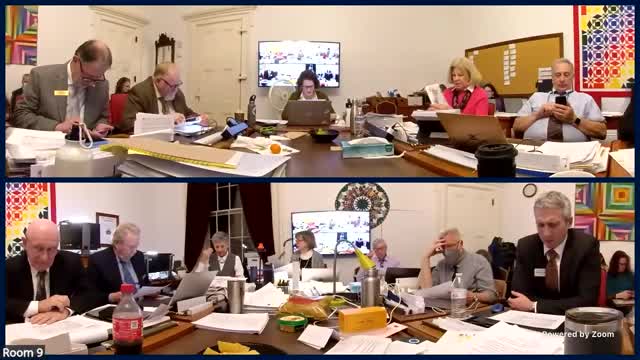
Summary
On March 1, 2025, the Vermont House Appropriations Committee reviewed Section C of the budget, confirmed several program funding changes and staffing reductions, and narrowed the gap toward a balanced FY2026 plan while leaving $20 million in bond redemption untouched.
The Vermont House Appropriations Committee on March 1, 2025, reviewed Section C of the draft FY2026 budget and agreed to a set of adjustments intended to reduce the projected shortfall and preserve bond redemption funds. Emily Burn of the Joint Fiscal Office told the committee the starting estimate of funds available for FY2026, after proposed adjustments, was about $126,000,000.
Committee members said the group would keep the $20,000,000 currently earmarked for bond redemption intact and considered several re‑allocations and rate changes to narrow the deficit. “The first bridge that I handed out is the C section of the budget,” Emily Burn, Joint Fiscal Office, said as she described the spreadsheet showing current‑year appropriation changes and open items.
Why it matters: the committee is shaping the House’s FY2026 budget recommendation, deciding which base (ongoing) expenses and one‑time items to fund. Those choices affect state agencies, local programs and a mix of policy goals such as housing, public safety, and human services.
Major decisions and open items
- Attorney General and related positions: Committee members agreed to reduce the Attorney General request to one pre‑charge administrative position rather than two positions and to lower the funded amount associated with the AG request. Committee members stated they were in agreement on that change.
- Crime victims and diversion funding: The committee agreed to reduce funding for pre‑charge diversion program grants (down from a prior figure represented as 1.7 to 1.1 on the working sheet) while adding $450,000 for crime victim advocates (listed in the spreadsheet as Center for Crime Victim Services, line 220). The combined adjustments were described in the meeting as bringing the net change for that pool to about 1.55 (spreadsheet units) compared with the earlier proposal.
- Family planning and FQHC match: The committee left in place a split appropriation that yields roughly the same total funding for family planning and the match for federally qualified health centers (FQHCs); staff described the apparent rounding that makes the line look like $90,000 but is effectively $85,000 for a specific rate change.
- Provider rate increases and human services network: The committee discussed rate increases for providers (district attorneys, supervisory social service agencies and similar providers). Members agreed to limit a proposed increase so it would buy roughly a 1.7% to 2% increase depending on coding changes; they later settled on lowering an infant and toddler rate increase from 5–5.5% down to a 4.5% option, which staff estimated would save roughly $1.088 million compared with a larger increase.
- Housing and VHFA items: The worksheet carried multiple housing items: a $7,500,000 VHFA rental loan fund placeholder, a $10,000,000 VHFA middle‑income loan program, and a $4.15 million VHFA line that includes funding for a position. The committee also carried a $5,000,000 placeholder for BHCB and discussed an $8,600,000 BHCB investment that—if included—would change the stabilization reserve calculation.
- One‑time program placeholders: Committee members carried a $300,000 placeholder for the cash crop/Crop Cash program, discussed $500,000 for Vermonters Feeding Vermonters and $300,000 level funding carried from last year for Crop Cash, and maintained other small program amounts (conservation districts, arts council, transportation pilot funds) to be resolved as part of the one‑time sheet.
- Human Rights Commission staffing: Committee members discussed the Human Rights Commission request for multiple FTEs (the commission had sought six FTEs and two part‑time roles in materials). The committee agreed to fund two positions from the state’s position pool (i.e., not creating net new FTEs) to address intake and legal backlog pressures.
- Transportation mileage‑based pilot: Members discussed a request for transportation mileage‑based user‑fee startup funding and considered a $1,000,000 addition to the existing $7.5 million set aside as a way to advance planning and avoid an 18‑month delay in securing federal support.
Reserves and bond money
Committee members emphasized that the $20,000,000 in bond redemption would remain “untouched” in the current construct; staff noted that whether the $8.6 million BHCB investment is included affects the stabilization reserve math (including whether the projected bottom line is more or less negative). One committee member summarized the current position as using about $10,000,000 of the $20,000,000 bond pool to help balance the plan while leaving the remainder with the treasurer for flexibility.
Next steps
Staff will reconcile the base and one‑time sheets, confirm agency line assignments (for example, where an Advance Vermont placeholder should map inside agency letters), and circulate updated worksheets before the committee’s next review. Committee members left several items highlighted as open for final decisions on the one‑time sheet, then agreed to reconvene on the consolidated numbers.
Notes: The committee’s discussion recorded multiple spreadsheet line references (Section C, line numbers, and working sheet totals) and several placeholders where program administration (which agency receives funds) was to be confirmed by staff.