Get Full Government Meeting Transcripts, Videos, & Alerts Forever!
Get email alerts on the Public Records topic
No spam. Unsubscribe anytime.
Bill would expand redactions for employment-investigation records; sponsors say it protects witnesses
Summary
House Bill 1934 would require agencies to redact job titles, email addresses, phone numbers, images and alter audio voices of complainants, accusers and witnesses in investigative records produced under the Public Records Act unless there is consent to disclose.
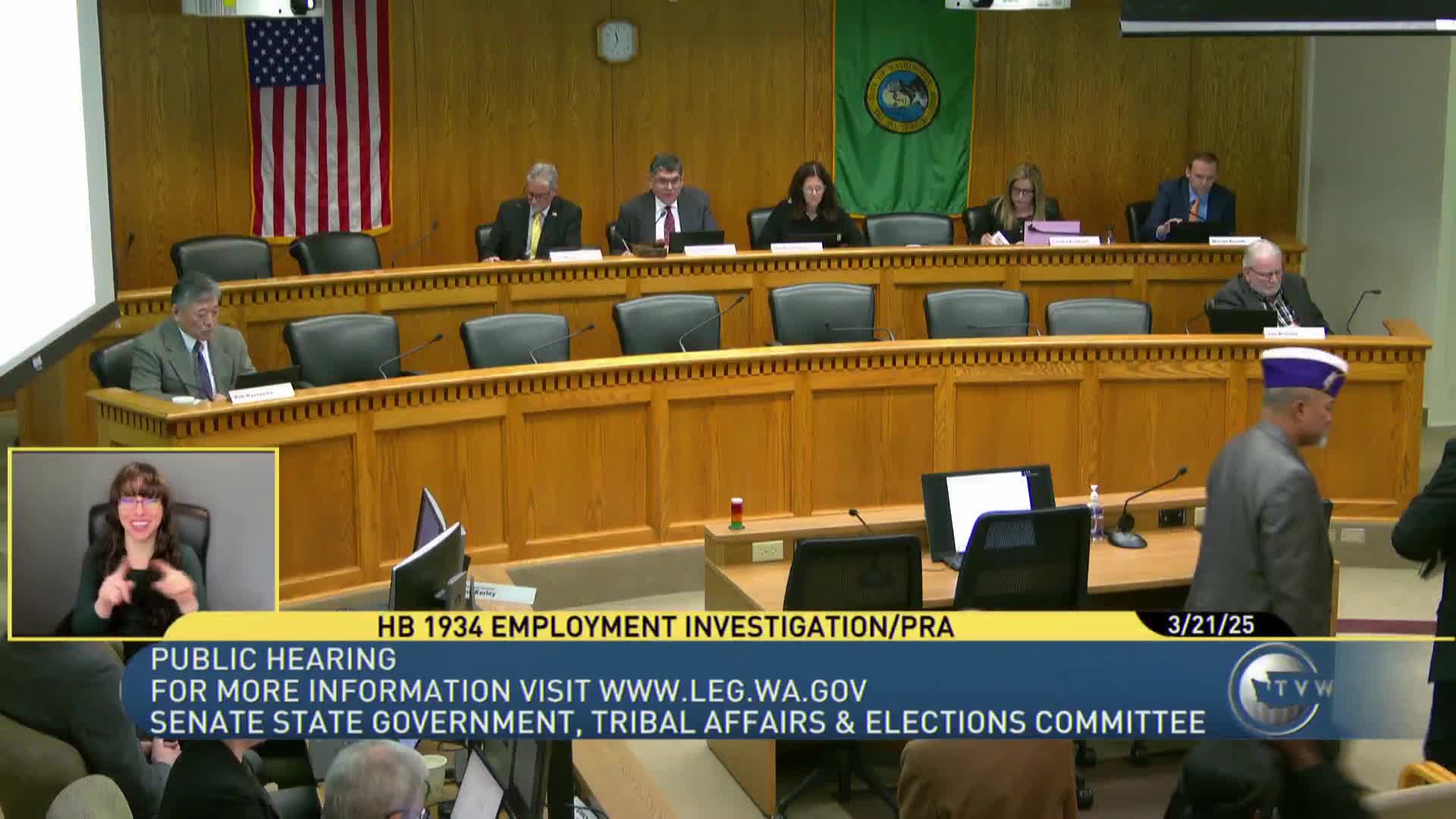
House Bill 1934, heard March 21 by the Senate State Government, Tribal Affairs & Elections Committee, would expand the Public Records Act exemption for investigative records compiled by employing agencies in connection with complaints of discrimination or harassment.
William, committee staff, summarized the bill: beyond existing redaction of names, agencies would be required to redact images, employee job titles, email addresses and phone numbers of complainants, accusers and witnesses; audio recordings’ voices must be altered while retaining inflection and tone. Those additional redaction requirements would not apply if a person consents to disclosure. William also noted a fiscal note: the Criminal Justice Training Commission estimated costs of $128,880 over four years for compliance, while OFM indicated no fiscal impact for its agency.
Representative Rob Chase, the bill’s prime sponsor, said the measure grew from a situation in Spokane Valley where complainants and witnesses reported harassment and asserted that identifying details released via public records requests led to retaliation. "This protects whistleblowers," Chase said, adding that email addresses and other identifiers made it easy to deduce who had provided information.
City officials and employee witnesses from Spokane Valley testified in support. Candace Bach of the Association of Washington Cities told the committee the bill is intended to prevent the Public Records Act from being used as a tool for harassment. John Whitehead, human resources director for the City of Spokane Valley, and Kelly Concrete, the city attorney, described employees’ fear of retaliation and said additional redaction will encourage reporting and participation in investigations. Several current and former Spokane Valley employees described how records released in the cited case were used on social media and on a council member’s campaign site to identify and publicly criticize city employees who had participated in an investigation.
Representatives of news organizations, including Roland Thompson of the Washington State Association of Broadcasters and Allied Daily Newspapers of Washington, said they negotiated narrowing language in the bill and warned the committee that the proposal raises questions about whether the object of an investigation (the respondent) would be able to learn the identity of accusers or witnesses in order to confront them; Thompson recommended clearer criteria for how agencies should handle internal notification when records are withheld under the exemption.
The committee heard multiple in‑person and remote witnesses; the transcript recorded many pro submissions (29 pro, 0 con, 1 other among non‑testifiers). Committee members asked staff to check how frequently identifying information has been released under current law; staff offered to follow up.