Get Full Government Meeting Transcripts, Videos, & Alerts Forever!
Get email alerts on the Prevailing Wages topic
No spam. Unsubscribe anytime.
Senate panel advances prevailing-wage records bill after heated privacy debate
Summary
The Senate Labor & Commerce Committee voted to pass Substitute House Bill 18 21, which would require Labor & Industries to provide employer certified payroll records to specified interested parties, after extended debate over employee privacy and proposed redaction and consent amendments.
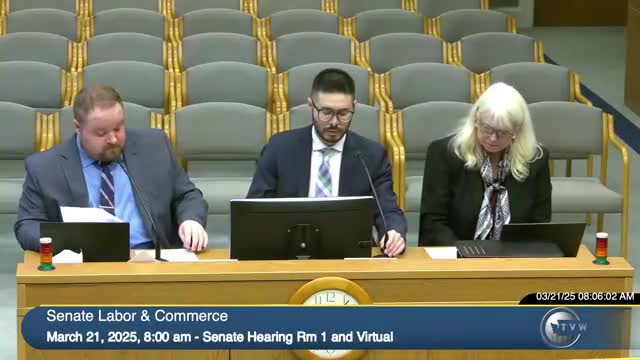
The Senate Labor & Commerce Committee on Friday voted to advance Substitute House Bill 18 21, a prevailing-wage measure that would require the Department of Labor & Industries (L&I) to provide an employer's certified payroll records to listed interested parties, including joint labor-management committees and Taft-Hartley trusts. The committee recommended the bill be sent to the rules committee; the passage was recorded by voice vote and is "subject to signatures."
The bill's sponsors say the measure is intended to help detect and deter violations in prevailing-wage contracting by giving interested parties access to payroll records. Opponents raised privacy concerns and pushed three amendments offered by Senator King that would have limited release or added protections: C.1 would have required requesters to attest under penalty of perjury that they would use the records only as permitted; C.2 would have required L&I to redact employees' personal addresses before release; and C.3 would have required notice to employees and their voluntary written consent before release. All three amendments failed on roll/voice votes; the bill passed unchanged.
Why it matters: Committee supporters and some senators described the bill as a tool to address the underground economy and unpaid prevailing wages, arguing that access to payroll records helps identify unfair competition and ensure workers are paid required wages and benefits. Opponents said the proposal risks exposing sensitive employee information and could enable uses beyond wage-enforcement, such as union organizing or commercial exploitation, without strong enforcement or penalty provisions.
During debate, Senator King framed the issue in privacy terms, saying the committee would be "giving out information that is really personal" and urging members to protect employee addresses and similar data. Other senators, including supporters of the bill, said the law already bars improper uses and that L&I's existing requester form includes an acknowledgement that records will not be used for commercial purposes. Senators also noted practical enforcement concerns: locating workers to investigate wage claims can be difficult, and redactions or consent requirements could impede L&I's and contractors' ability to verify compliance.
The fiscal note attached to the bill shows no anticipated fiscal impact. The committee discussion referenced provisions considered in the earlier House committee and compared the substitute to an earlier Senate bill on similar topics. The committee record shows that the bill passed by voice vote; specific yea/nay counts were not provided in the transcript.
Votes at a glance: Substitute House Bill 18 21 — Motion: do pass; referral: rules committee; outcome: passed (voice vote; counts not specified); notes: three King amendments (C.1, C.2, C.3) were proposed and defeated. Fiscal note: no fiscal impact stated.
The committee chair said the panel will forward the bill to the next committee stage; signatures are required to complete the process. If enacted as written, L&I would be required to release certified payroll records to the listed parties under the conditions in the bill.