Get Full Government Meeting Transcripts, Videos, & Alerts Forever!
Get email alerts on the Wildfire Mitigation topic
No spam. Unsubscribe anytime.
Committee hears bill to require UTC approval of investor‑owned utilities' wildfire mitigation plans
Summary
Engrossed House Bill 1522 would require investor‑owned electric utilities to file wildfire mitigation plans with the Utilities and Transportation Commission for approval, update plans every three years, and align filings with multiyear rate plans. Utilities and industry groups supported oversight and frequent updates.
The Senate Environment, Energy & Technology Committee took testimony on Engrossed Substitute House Bill 1522, which would create a statutory process for the Utilities and Transportation Commission to review and approve investor‑owned electric utility wildfire mitigation plans.
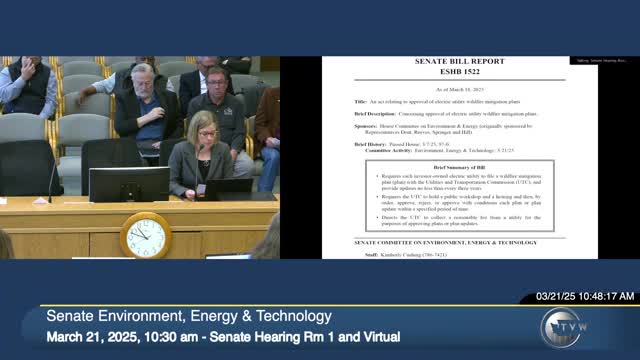
Kim Cushing, committee staff, summarized the bill and its background. The statute would repeal the existing investor‑owned utility wildfire plan statute and require investor‑owned utilities to file plans with the UTC “as soon as possible” after the new law takes effect. The UTC would have between 90 and 120 days to approve, reject or approve with conditions a plan after holding at least one public workshop and a hearing, staff said. The bill also directs the UTC to adopt rules addressing vegetation management, public power safety shutoffs and service restoration, and requires a UTC fee to cover plan review.
Representative (Rep.) Dett (identified in the hearing record) described the bill as the product of multi‑year stakeholder negotiations and emphasized that approval and continuity of wildfire mitigation plans were aimed at preventing catastrophic fires. Dett told the committee the bill focuses on planning and does not provide liability protection to utilities.
Utility witnesses — including John Rothlin of Avista, Jay Balaspas of PacifiCorp and Matt Miller of Puget Sound Energy — voiced support for the bill. They described existing mitigation activity, noted the value of public stakeholder input and said UTC review would add regulatory rigor. Industry witnesses and credit‑market representatives also suggested that a formal approval process could be viewed positively by credit rating agencies and thereby reduce borrowing costs for utilities over time.
A staff fiscal note attached to the bill notes a projected state General Fund impact of just over $200,000 per biennium to the Department of Commerce’s Energy Resilience and Energy Management Office for subject‑matter expertise, training and workshop support.
Ending: Committee members asked clarifying questions about scope and whether the UTC process would create meaningful additional protections or costs. The hearing record closed with utility and industry support for the bill; no committee vote was taken on Tuesday.