
Committee reviews H.474 amendment to list late write‑in candidates; clerks and Secretary of State caution on 7 p.m. deadline
Get AI-powered insights, summaries, and transcripts
Subscribe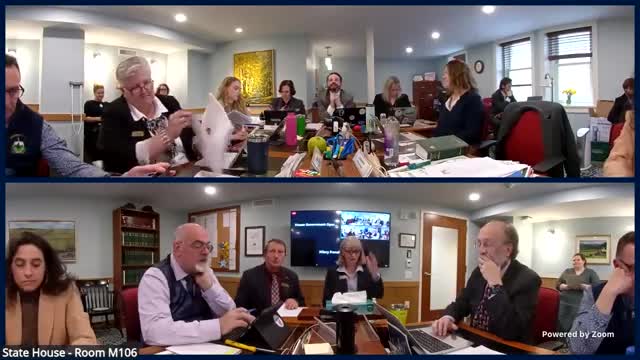
Summary
The House Committee on Government Operations & Military Affairs reviewed draft 1.2 of an amendment to H.474 that would require write‑in candidates to file by 7 p.m. on primary day to have votes listed by name; clerks and the Secretary of State raised logistical and timing concerns.
The House Committee on Government Operations & Military Affairs reviewed draft 1.2 of an amendment to H.474 that would require write‑in candidates for General Assembly, state and federal offices to file a form by 7 p.m. on primary election day in order for their write‑in votes to be recorded with the candidate’s name rather than as “other write‑ins.” The committee heard testimony from municipal clerks, the Secretary of State’s office and legislative counsel about logistical challenges and related campaign‑finance and petition changes in the amendment.
The amendment would strike sections 2 and 3 of the introduced bill and replace section 9 with new language that (1) moves the filing deadline for write‑in candidates to 7 p.m. on primary day, (2) allows a filer to submit the Secretary of State’s form either to all town clerks in the district or electronically to the Secretary of State, and (3) directs clerks to list by name only write‑in candidates who have filed in accordance with the statute; write‑in votes for non‑filers would be recorded as “other write‑ins.” The proposal repeats the change for multiple statutory sections so it applies across presidential, statewide and primary contests.
Why it matters: Clerks said pre‑registering write‑in candidates helps ballot counters recognize variant names, avoid missed votes and reduce hours of manual counting after polls close. Hillary Francis, Brattleboro Town Clerk and a member of the Vermont Municipal Clerks and Treasurers Association legislative committee, told the committee that "If ballot counters were provided with a list of write in candidates, they would be on alert for those names and may be able to attribute votes to a particular write in candidate even though the name may not be complete." The Secretary of State’s office said it supports the amendment’s intent but urged more work on the 7 p.m. timing to make it operational statewide.
Details of committee discussion - Deadline and counting: Legislative Council walked members through draft 1.2 and the statute cross‑references. The amendment replaces the prior deadline (the second Friday preceding the primary, as in the introduced bill) with a 7 p.m. same‑day filing requirement for write‑ins in the enumerated sections. The bill also includes a "notwithstanding" clause: a write‑in who did not file by the deadline would still qualify as a primary winner if the candidate otherwise meets the statutory requirements for winning the contest; ballots for non‑filers would be tallied as aggregated write‑ins on tally sheets.
- Local logistics and access: Multiple town clerks and clerks’ association witnesses cautioned that election night is “chaotic,” that some polling places lack cell or internet service, and that asking clerks or poll workers to retrieve filings or print updated tally sheets at 7 p.m. would pose real operational problems. Francis described frequent name‑ambiguity on ballots in larger town checklists and said prior declarations make it easier to credit votes. Another municipal clerk noted many write‑ins receive only one or two votes and that hand‑counting write‑in names can consume hours of staff time.
- Secretary of State’s position: Lauren Hibbert, Deputy Secretary of State, said the office "does think that we need to have further conversations, particularly with our vendor and with the clerks, both the town clerk association and the clerks that are not represented in the association, to fully understand the logistics of how that would work." The office indicated it may seek technical changes on the Senate side to ensure the filing method and deadline are operationally feasible, and said it prefers electronic filing to a candidate visiting every town clerk in a multi‑town district.
- Campaign finance and treasurer disclosure: The amendment also alters candidate registration and campaign‑finance triggers. It removes threshold dollar amounts tied to initial registration and ties the requirement to provide bank account details to the first acceptance or expenditure of campaign funds, while retaining a requirement that a candidate disclose the name and address of the treasurer when filing. The Secretary of State urged moving the treasurer disclosure into the initial registration so the office always knows who is responsible for a campaign’s funds.
- Petition and municipal timing: Witnesses flagged language that would change the municipal petition deadline from the sixth Monday before an election to the fifth Monday. Former town clerks and current municipal clerks said shaving a week from the printing timeline increases risk: printers, clerks and local officials have limited windows to proof ballots, reprint if necessary and meet statutory mailing deadlines.
Concerns and tradeoffs Committee members balanced the sponsors’ goal—to avoid disenfranchising voters whose write‑ins should be attributed to a candidate—with the state and local officials’ concerns about workload and error risk. Representative McCoy argued the change protects voters who write in names late and said he did not want voters’ choices to be “violated” by administrative processes; he also noted that for some offices a candidate can qualify for the general election only after receiving a specified number of write‑in votes (he cited an example figure of 50 votes for a particular nomination threshold).
The Secretary of State warned that moving the filing window later would strain a small central staff and two vendors responsible for tabulation and ballot printing; the office described multiple layers of review across up to 283 ballot styles and said adding late filings increases the chance of inadvertent errors.
Next steps Committee members asked sponsors and counsel to refine language, produce a side‑by‑side comparison of the amendment and the introduced bill, and to consult further with clerks and the Secretary of State over the weekend. The chair scheduled a follow‑up committee call for 9 a.m. Tuesday before the bill’s floor report. Members signaled willingness to preserve the amendment’s intent while adjusting technical language — including the filing method and the municipal petition calendar — so the provision can be implemented without undue risk to election administration.
Ending note: The committee did not take final action on the amendment during the hearing. Witnesses from municipal clerks and the Secretary of State’s office asked for additional drafting time to resolve operational details before the committee votes and the bill moves to the House floor.