Get Full Government Meeting Transcripts, Videos, & Alerts Forever!
Get email alerts on the Utilities Finance Securitization topic
No spam. Unsubscribe anytime.
Committee hears bill to allow utilities to securitize disaster repair costs; utilities, AG offer differing guardrails
Summary
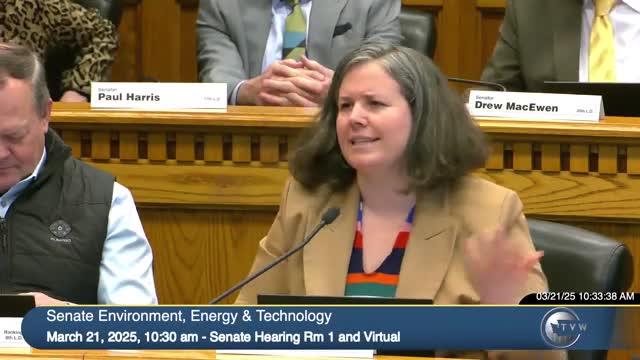
The Senate Environment, Energy & Technology Committee on Tuesday heard public testimony on House Bill 1990, which would let utilities securitize some disaster and emergency costs by petitioning the Utilities and Transportation Commission.
The Senate Environment, Energy & Technology Committee on Tuesday heard public testimony on second substitute House Bill 1990, which would allow water, electric and gas utilities to petition the Utilities and Transportation Commission to issue a financing order permitting securitization of certain disaster and emergency costs.
Kim Cushing, staff to the committee, told members the bill would let investor‑owned utilities ask the UTC to designate “bondable expenditures” tied to events subject to a federal or state disaster or emergency declaration and to recover those costs through bonds and a dedicated rate recovery charge. The bill, as described by staff, excludes criminal or civil penalties but otherwise contemplates UTC review of whether the costs are “reasonable and prudent.”
Representative Peter Abarno (R‑20th District), the bill’s prime sponsor in the House, said the tool is intended to spread unusually large, unexpected repair costs over time so customers are not hit with a sudden spike in rates after events such as wildfire, catastrophic flooding or earthquakes. “When a catastrophic event happens … we need to provide as many options for utilities and the UTC to get power to those folks, to get clean water to those folks without the impact to the ratepayer happening all at once,” Abarno said.
Utility witnesses largely supported the bill. Jay Balaspas (Pacificorp), Matt Miller (Puget Sound Energy) and John Rothlin (Avista) told the committee securitization is a rarely used financing tool in other states that can lower customer costs by spreading repayment and by signaling confidence to credit markets. They said the bill preserves a UTC process that would require a separate petition, opportunities for intervenors, and a prudence review before any financing order could issue.
Tad O’Neil, assistant attorney general in the Public Counsel Unit, testified in opposition unless amended. O’Neil said the office supports the general purpose of the bill but requested a specific amendment allowing the UTC to consider whether a utility was negligent or grossly negligent in causing the disaster when deciding what costs are recoverable. He cited out‑of‑state jury findings that established utility negligence in wildfire litigation as an example of where a narrowly worded recovery rule could allow costs tied to negligence to be shifted to ratepayers.
Committee members asked about the relative urgency of wildfire risk compared with other disaster types and whether the bill should be restricted to certain utilities or hazards. Witnesses and the sponsor said wildfire is the most prominent and urgent risk in the West but emphasized the bill’s text covers a broader set of federally or state‑declared disasters, including floods and earthquakes. Utility witnesses and the sponsor said the UTC proceeding is the appropriate venue to sort prudence, cost allocation and other technical issues.
No committee action or vote on HB 1990 occurred at the hearing; the committee suspended the public hearing and later took testimony from remaining proponents. Committee members indicated interest in technical amendments and in the attorney general’s proposed language to address recovery of costs tied to negligence.
Votes at the committee were taken later in executive session on other bills; HB 1990 remained at the public hearing stage at adjournment.
Ending: The committee did not advance HB 1990 on Tuesday. Sponsors and stakeholders signaled they expect additional negotiation on specific UTC‑process language, the role of negligence findings, and how charges would be allocated across customer classes if the bill moves forward.