Get Full Government Meeting Transcripts, Videos, & Alerts Forever!
Get email alerts on the Universal Health Care topic
No spam. Unsubscribe anytime.
Universal Health Care Commission briefs committee; memorial seeks federal waivers and state pathway to universal coverage
Summary
The House Health Care & Wellness Committee received an update from the Universal Health Care Commission and public testimony on Senate Joint Memorial 8004, which requests federal action or waivers to allow Washington to pursue a state-based universal health care financing system.
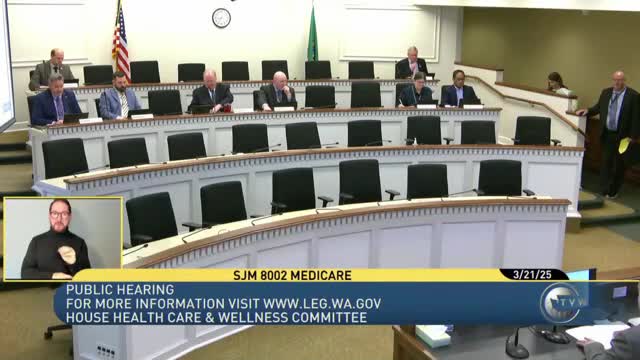
The House Health Care and Wellness Committee heard an update on the work of the Universal Health Care Commission and took public testimony on Senate Joint Memorial 8004 on March 21.
Health Care Authority staff Ross Valori, director of boards and commissions, and Mary Franzen, coverage strategies manager who staffs the commission, briefed the committee on the commission’s mandate and current workplan. Valori and Franzen described universal health care in the commission’s terms as a single, unified system giving all residents access to care, which can be organized under multiple models—including single-payer and multi‑payer approaches—and may use a mix of public and private financing.
The commission was created by the legislature in 2021 with two directives: pursue immediate, impactful changes that improve access and prepare the state for a unified health care financing system once federal authority is available. Franzen described the commission’s membership (a 15‑member body that includes state agencies, governor appointees and legislators) and noted the Finance Technical Advisory Committee (created in 2023) is modeling costs and evaluating mechanisms to contain costs and set provider reimbursement recommendations.
Franzen said the commission is focusing the early part of 2025 on universal system design and plans to return to transitional solutions in the latter half of the year. The commission’s 2025 legislative report is due November 1, 2025. The staff presentation listed candidate initial populations for an early transition (Medicaid enrollees; people in individual market plans; fully insured group plans; public employees and school employees; uninsured) and described priorities such as administrative simplification, prior authorization reform, strategies to increase provider participation in public programs, and reference‑based pricing support for some public plans.
Senator Bob Hasegawa, prime sponsor of SJM 8004, told the committee the memorial gives Congress options: pass federal legislation enabling state‑based universal systems, grant waivers to allow states to use federal funds within a state plan, or partner with states on administrative options. Hasegawa said securing federal waivers has been described to him as a necessary step to allow states to apply federal funds toward a state‑designed universal financing system.
The memorial and the staff briefing prompted public testimony both for and against state efforts toward universal coverage. Supporters included advocates for people with disabilities, health care workers and organizers for a state health trust. Anna Schroeder, a nurse, said she has seen preventable injuries and chronic disease worsen because people lacked continuous access to care and urged support for SJM 8004. Several witnesses, including Nico Janssen from the Office of the Insurance Commissioner, said the OIC supports continuing the work; the OIC noted it receives consumer complaints about Medicare Advantage but lacks regulatory authority over those plans.
Opponents warned of cost and access risks based on other jurisdictions. Testimony referenced international and state examples—Canada and Vermont were cited—arguing higher taxes, wait times and fiscal strain could follow a taxpayer‑financed universal system.
Committee members asked for clarification on the waiver process, which bodies submit waivers and the likely timeline. Health Care Authority staff said there are multiple types of federal waivers and offered to provide additional detail to the committee. The commission’s staff also agreed to provide the committee’s milestone tracker and the legislative report timeline on request.
No formal committee vote was taken on SJM 8004 at the March 21 hearing. The memorial asks the federal government to grant waivers or provide statutory authority; its effect depends on subsequent federal action and any state design and implementation decisions.