Get Full Government Meeting Transcripts, Videos, & Alerts Forever!
Get email alerts on the Child Hearsay topic
No spam. Unsubscribe anytime.
Prosecutors back broader child-hearsay rule; defense and innocence groups warn of wrongful-conviction risk
Summary
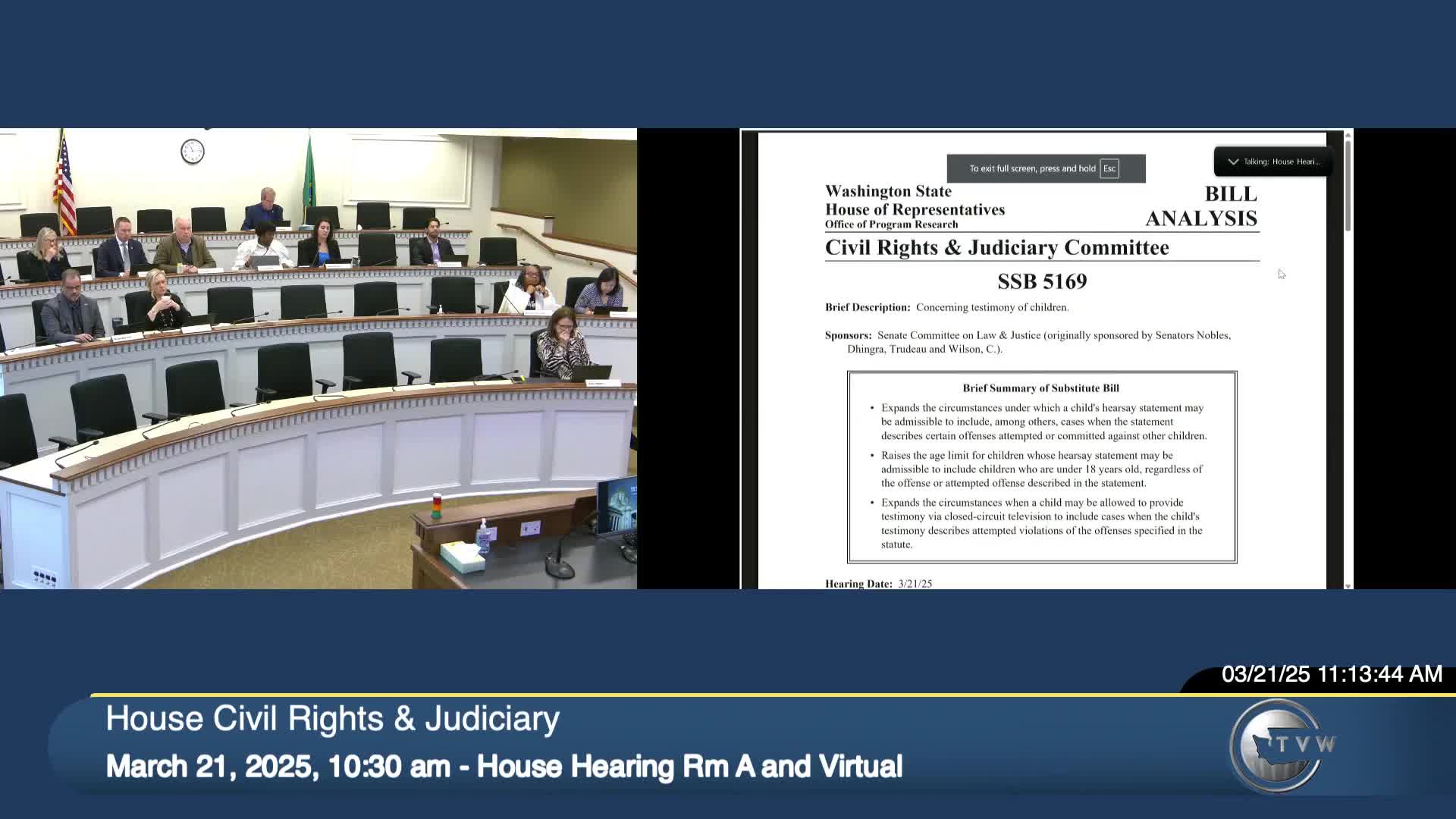
The Civil Rights & Judiciary Committee on March 21 heard sharply divided testimony on Substitute Senate Bill 5169, which would expand circumstances under which a child’s out-of-court statements may be admitted in criminal and dependency proceedings.
The Civil Rights & Judiciary Committee on March 21 heard sharply divided testimony on Substitute Senate Bill 5169, which would expand circumstances under which a child’s out-of-court statements may be admitted in criminal and dependency proceedings.
Yolanda Baker, committee staff, summarized the proposal and said the bill would expand the list of offenses that may be described in a child's hearsay statement, raise the age limit so that statements by anyone under 18 could potentially be admissible (subject to other statutory conditions), and allow closed-circuit testimony where a child’s statement describes attempted offenses in the listed categories. Baker explained the current hearsay exception is limited by the child’s age and to certain types of offenses and that the bill would broaden those categories.
Deputy prosecuting attorneys described courtroom limitations under the current rule. Lindsay Chenalia of the Pierce County Prosecutor’s Office told the committee of a case in which a 5-year-old witness who described a shooting could not have her child interview used at trial “because she was not injured.” Chenalia said such restrictions prevent jurors from seeing forensic interviews that often contain coherent, nonleading narrative accounts and force prosecutors to choose between plea offers and risking loss at trial when children cannot testify effectively due to trauma or memory fade.
Corine Schneff and Anita Petro, senior prosecutors, similarly urged passage, saying changes would bring the hearsay statute into alignment with the closed-circuit testimony statute and reduce trauma for young witnesses who might otherwise freeze on the stand.
Defense, innocence and public-defense voices opposed the bill. John Marlow, litigation director at the Washington Innocence Project and a survivor of childhood abuse, warned that expanding the exception “will also greatly increase the risk of wrongful convictions in our state.” Kate Benward, associate special counsel at the King County Department of Public Defense, said the proposal would make Washington “an extreme outlier” by applying hearsay exceptions to youth up to age 18 and to a broad range of offenses; she said the change would raise “significant constitutional challenges” tied to the Sixth Amendment right to confront witnesses. Carrie Reardon of the Washington Defender Association and Washington Association of Criminal Defense Lawyers said the expansion goes “very far” and risks undermining defendants’ confrontation rights.
Committee members asked whether the bill would impinge on confrontation rights and whether forensic interview protocols adequately guard against leading questions. Prosecutors responded that testimonial statements still require adherence to confrontation protections and that defense counsel have access to forensic interview recordings and can raise concerns about interview technique; they also noted established protocols and training for forensic interviewers designed to minimize leading questions.
No vote on SSB 5169 was recorded in the transcript portion provided. The hearing record shows robust division: prosecutors and victim-advocate witnesses emphasized child trauma and loss of evidence when interviews cannot be admitted; defense and innocence advocates emphasized constitutional protections and the recorded history of wrongful convictions tied in other jurisdictions to overly broad hearsay usage.
Ending: The committee closed public testimony with testimony both urging adoption to reduce trauma and preserve evidence and opposing adoption because of confrontation and wrongful-conviction risks. The transcript includes requests for written materials on constitutional authorities and for further analysis; no committee action on the bill is recorded in the provided excerpt.