Get Full Government Meeting Transcripts, Videos, & Alerts Forever!
Get email alerts on the Tax Policy Alcohol topic
No spam. Unsubscribe anytime.
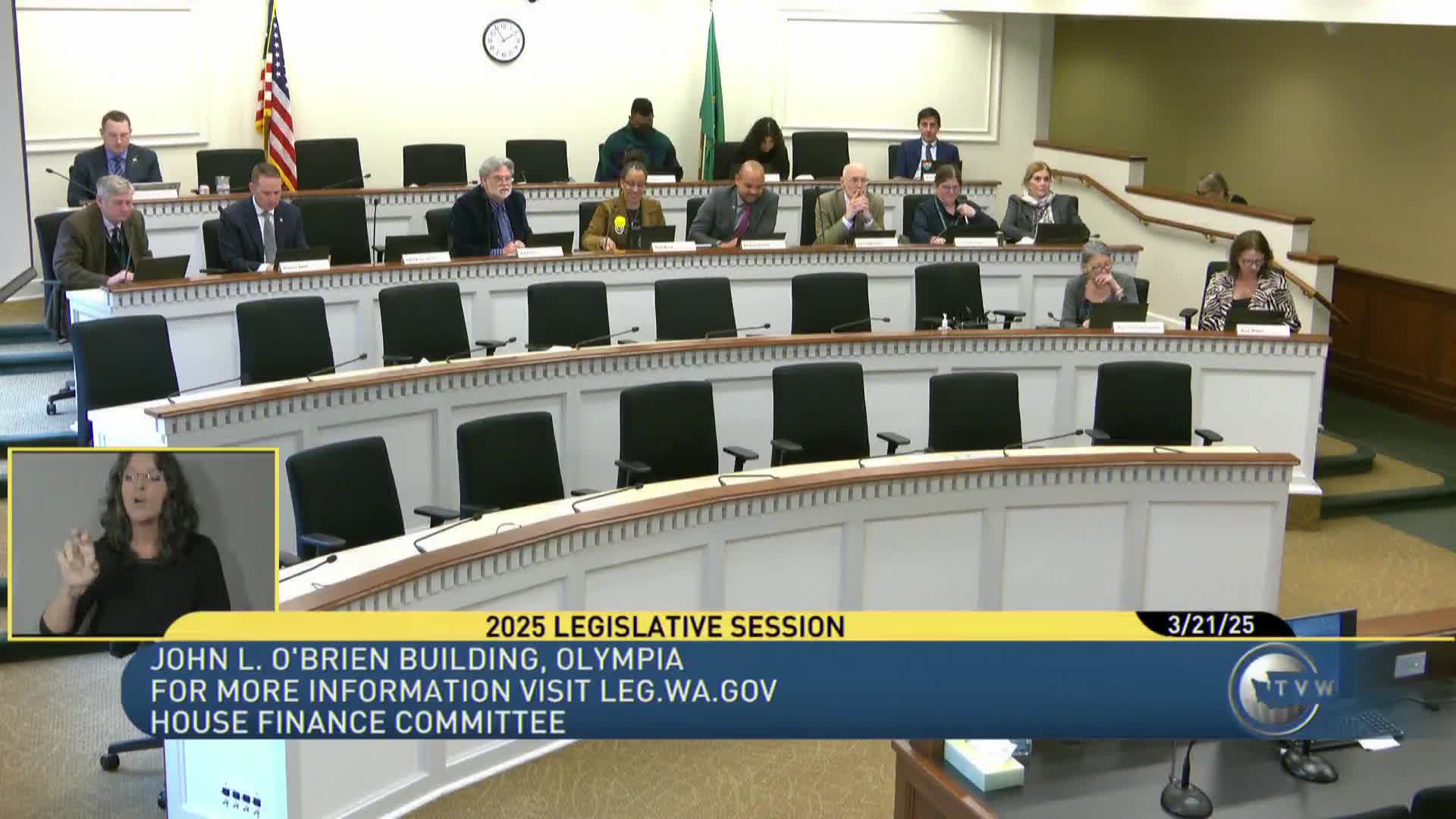
House Finance hears wide-ranging testimony on bill directing a study of Washington’s alcohol tax system
Summary
A bill directing a Washington State Institute of Public Policy study of alcohol taxation drew support from distributors and retailers and opposition from wine and brewery trade groups concerned about industry impacts and study scope and cost.
Rochelle Harris and staff summarized Engrossed Substitute Senate Bill 5368, which directs a state research institution to study Washington’s system of alcohol taxation and produce a report by June 30, 2026. The bill asks for current and historical tax and fee rates, state sales and per‑capita measures, revenues by tax/fee type for the last five years, comparisons to other states and countries, and an analysis of a model in which tax rates are based solely on alcohol content (including estimated transition and administration costs and revenue-neutral rate estimates). The briefing noted the Washington State Department of Revenue and the Liquor and Cannabis Board would provide data; a fiscal note is available.
Representative Springer, the bill’s House sponsor, told the committee the measure responds to a long-standing legislative discussion over the disparate tax treatment of products that have similar alcohol content but fall into different categories (beer, wine, spirits). He said the study will “ferret out the data we need to make decisions,” not itself change tax law.
Supporters from distributors and retailers told the committee the market has changed since current taxes were set and that products now blur traditional category lines. Vicky Kristofferson of the Association of Washington Spirits and Wine Distributors said examples include spirit‑like products sold under malt or wine tax classifications and low‑alcohol spirits products that look more like beer. “So beer is taxed at 26¢ a gallon, wine at 84¢ a gallon, and spirits at $24 a gallon,” Kristofferson said, arguing the study would provide information to consider modernizing the system. Southern Glazer representatives and convenience-grocer advocates likewise urged a study, saying consumer choices and product innovation create complexities the current tax code does not reflect.
Trade groups opposed or urged caution. The Washington Wine Institute’s Josh McDonald and the Washington Brewers Guild’s Daniel Olson objected to the study, raising concerns it could lead to changes that disadvantage Washington wineries and small breweries. McDonald said Washington already has one of the highest wine tax rates in competing states and asked that any review look farther back than five years (to include privatization and pandemic effects). Daniel Olson said small craft breweries are under pressure from declining beer sales, tariffs and rising costs and warned a restructured system could harm local producers.
Staff provided cost estimates during the hearing: roughly $171,000 for the study by the research institute and an estimated $60,000 for DOR participation. Committee members asked whether the study would include data on consumption responses to tax changes and whether a revenue-neutral redesign could avoid imposing large increases on beer and wine; sponsors and supporters said the study’s purpose is to provide lawmakers the information needed to answer those questions. Representative Raimel emphasized the bill requests information and that any policy change would still be made by the Legislature.
After a lengthy panel of in-person and remote witnesses, the committee closed the public hearing on SB 5368; no vote was taken during the meeting.