
Committee scales back capital funding for three housing-related projects, moves $2 million to cash fund B with conditions
Get AI-powered insights, summaries, and transcripts
Subscribe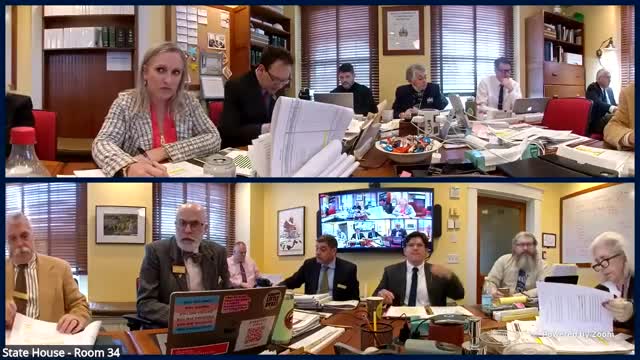
Summary
The House Corrections Institutions Committee reduced an administration proposal for three privately developed projects from $3.1 million to $2 million and shifted the money into cash fund subaccount B, while debating statutory timing, affordability requirements and program design.
The House Corrections Institutions Committee on Thursday, March 20, agreed to reduce the administration—s $3.1 million capital proposal for three privately developed projects to $2 million and move that sum into cash fund subaccount B, while negotiating restrictions and release conditions for the funds.
The move, made during a discussion of draft language in section 25 of the bill, is intended to keep the Appropriations Committee "harmless" and to track the appropriation within the committee—s budgeting process. Committee members said they want triggers and reporting before funds are released; administration officials warned some of those requirements could delay awards and complicate program administration.
Committee leaders said the reduced amount and the decision to house the money in cash fund B grew from a subgroup—s review. Committee members emphasized the choice was intended to avoid opening the capital bill to a broader set of smaller projects while still advancing the three developments identified by the administration.
Commissioner Alex Farrell of the Department of Housing and Community Development told the committee the administration did not support cutting the package from $3.1 million to $2 million and preferred funding the three projects directly rather than running them through a new competitive grant program. "The administration doesn't support the reduction from 3.1 to 2, and also would prefer we'd recommend that these 3 projects be funded and then this grant program be established going forward for future years," Farrell said on the record.
Farrell and other administration witnesses also flagged two provisions as problematic in the committee—s draft: a requirement (c.5 in the draft language) that awards go only to projects with permanently affordable housing, and a proposed pre-award "check back" that would require further committee review before grants could be made. Farrell said c.5 would be "a pretty strict standard" because only one of the three projects identified in testimony would meet a permanent-affordability test as currently written.
Nick Kramer, chief operating officer of the Agency of Administration (AOA), told members there is $1 million currently in cash fund subaccount B and that an additional $1 million would be needed to support a $2 million program in that subaccount. Kramer also summarized an operational concern across agencies: under current statute (32 V.S.A. § 1001b), cash-fund appropriations must be encumbered within two years or the unencumbered spending authority remains part of the fund account, a provision that could force agencies to "freeze" spending authority absent a statutory fix. Kramer said the department—s financial operations team interprets the provision narrowly and that the committee may want either temporary language to extend the encumbrance window or to align cash-fund reallocation timing with bonded-dollar reallocation processes.
Committee members and administration witnesses disagreed over tradeoffs. Administration officials argued that requiring committee-level sign-off before awards would delay grant awards until spring 2026 rather than a July award timeline under the governor's recommendation. Committee members said they feared placing the projects directly into the capital bill would set a precedent inviting many smaller projects into the bill and divert scarce bonding and capital resources.
Several members raised local project-readiness concerns. A representative from one affected community said local managers and selectboard members reported shifting project scopes and cost estimates over multiple discussions; that representative warned the community could lose momentum without targeted funding. Kramer and the administration acknowledged the projects had been assessed for readiness, community support and alternate funding sources but said changes in project details are not uncommon during budget development.
The committee agreed to continue working on the statutory language, to coordinate with Appropriations on any transfers needed to fund subaccount B, and to seek clarifying language about the two-year encumbrance rule before final action. The committee took a short recess to allow staff to continue technical drafting.
Committee members did not record a formal roll-call vote on the reduction during the exchange captured in the transcript; the committee described the funding change as a decision of the subgroup and the committee process rather than a formal, recorded vote.