Committee frames 'notwithstanding' reallocations and directs simpler transfer approach for select items
Summary
Committee members agreed to include targeted 'notwithstanding' language for selected prior project balances and to handle a $2,000,000 ACCD transfer as a direct transfer rather than routing through a cash subaccount.
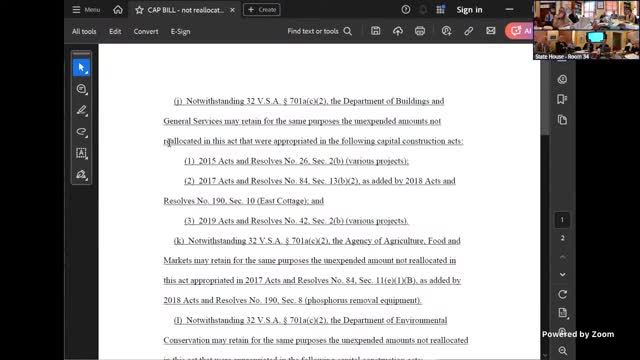
The drafting committee reviewed a set of reallocations of prior, unexpended capital appropriations and agreed to include targeted 'notwithstanding' language in the bill for specific agency projects while using a simpler direct‑transfer method for at least one large reassignment.
What the committee reviewed Staff presented a compiled list of prior projects with unexpected balances that the administration recommended be retained or reclaimed. The list included project balances associated with Buildings & General Services, Agency of Commerce & Community Development (ACCD), Agency of Transportation and others. For most items the committee supported limited 'notwithstanding' language allowing the lead agency to retain a project’s unexpended balance for the same purpose.
Simpler transfer for ACCD item Committee staff and JFO advised that, for the $2,000,000 originally described as entering subaccount B of the cash fund and then being moved to an ACCD project, a direct transfer method would be cleaner: reduce the initial deposit into the cash account by $2,000,000 and instead appropriate that amount directly in the appropriations bill to the recipient agency. Committee members agreed this approach accomplishes the same fiscal effect with fewer intermediary steps and simpler tracking.
Why it matters The 'notwithstanding' sections prevent automatic reversion of old balances while giving the committee and agencies explicit legal authority to reallocate or retain funds. At the same time, the direct transfer approach avoids creating interim cash fund accounting steps that complicate transparency and spreadsheet reconciliation.
Next steps Staff will insert the 'notwithstanding' list at the end of the reallocation sections, verify the specific project entries with agency counterparts, and rewrite the ACCD $2,000,000 item as a straightforward transfer that will show up in Appropriations rather than as a deposit into subaccount B.
Ending Committee members asked staff to confirm the list of projects and finalize the transfer language for Appropriations' spreadsheet. Once updated, staff will circulate the revised bill for final committee review before it moves to Appropriations.