Get Full Government Meeting Transcripts, Videos, & Alerts Forever!
Get email alerts on the Environmental Safety topic
No spam. Unsubscribe anytime.
Council approves MVRTA permit to replace underground diesel tank with above-ground, double-walled tank
Summary
After a public hearing, the council approved a special permit for Merrimack Valley Regional Transit Authority to replace an aging underground diesel tank with an anchored, above-ground double-walled tank; councilors and neighbors questioned flood and safety risks before the 10–0 vote.
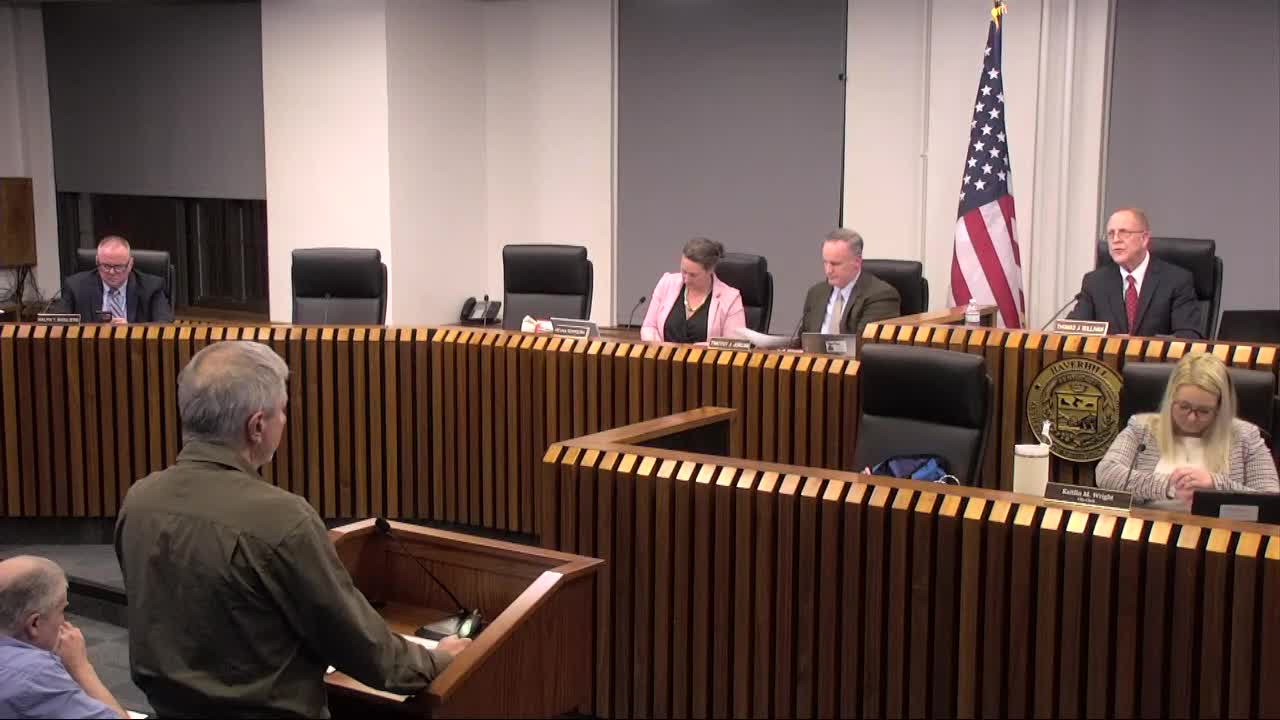
The Haverhill City Council voted unanimously on March 11 to approve a special permit allowing the Merrimack Valley Regional Transit Authority (MVRTA) to replace an aging underground diesel tank with an anchored, above-ground, double-walled tank at 125 Railroad Ave.
Robert Coluccio of Webb Engineering Associates, representing the MVRTA, said the diesel tank had reached the end of its useful life and that the authority proposed an above-ground fire-protected tank because it would be easier to inspect and maintain. "The diesel tank has gotten quite old, and they're concerned…they decided above ground was probably more environmentally friendly," Coluccio said during the hearing.
Ed Nutter, MVRTA facilities manager, told the council he has worked at the site nearly 20 years and supported the replacement. Neighbors asked how the tank would perform in a flood and whether an above-ground tank could be damaged and release fuel. Coluccio said the above-ground design would be anchored and engineered to resist buoyancy and flood forces; the double-walled tank includes a monitored interstitial space and meets the state fire marshal and NFPA requirements. He said the diesel tank is similar in behavior to home heating oil and has a higher flash point than gasoline.
Resident Bert Lasert asked whether an above-ground tank posed greater flood risk than an underground tank. Coluccio said a properly anchored above-ground tank was preferable to an old underground tank near the river because underground tanks can fail and release product into groundwater; he said the above-ground tank will be designed to the state and federal spill-prevention standards and carry sensors that alarm if the interstitial space sees liquid.
After public comment, the council voted to approve the special permit (roll call recorded as 10 yeas, 0 nays, 1 absent). Council discussion noted that an above-ground, inspected installation reduces the length of underground piping (from roughly 200 feet underground piping to approximately 15 feet of above-ground piping) and eases inspection of valves and fittings.
The applicant must complete design and obtain state fire marshal approval and comply with applicable DEP spill-prevention rules and state fire code before construction.