Get Full Government Meeting Transcripts, Videos, & Alerts Forever!
Get email alerts on the Debt And Bonding topic
No spam. Unsubscribe anytime.
Treasury, DAS present Oregon debt picture; governor's budget proposes about $2.2 billion in GO bonds and $571 million in lottery bonds
Summary
At a March 2025 informational meeting of the Legislature’s Ways and Means capital construction subcommittee, the State Treasury and Department of Administrative Services outlined Oregon’s debt levels, credit ratings and models for general obligation and lottery bond capacity and described projects included in the governor’s proposed bond package.
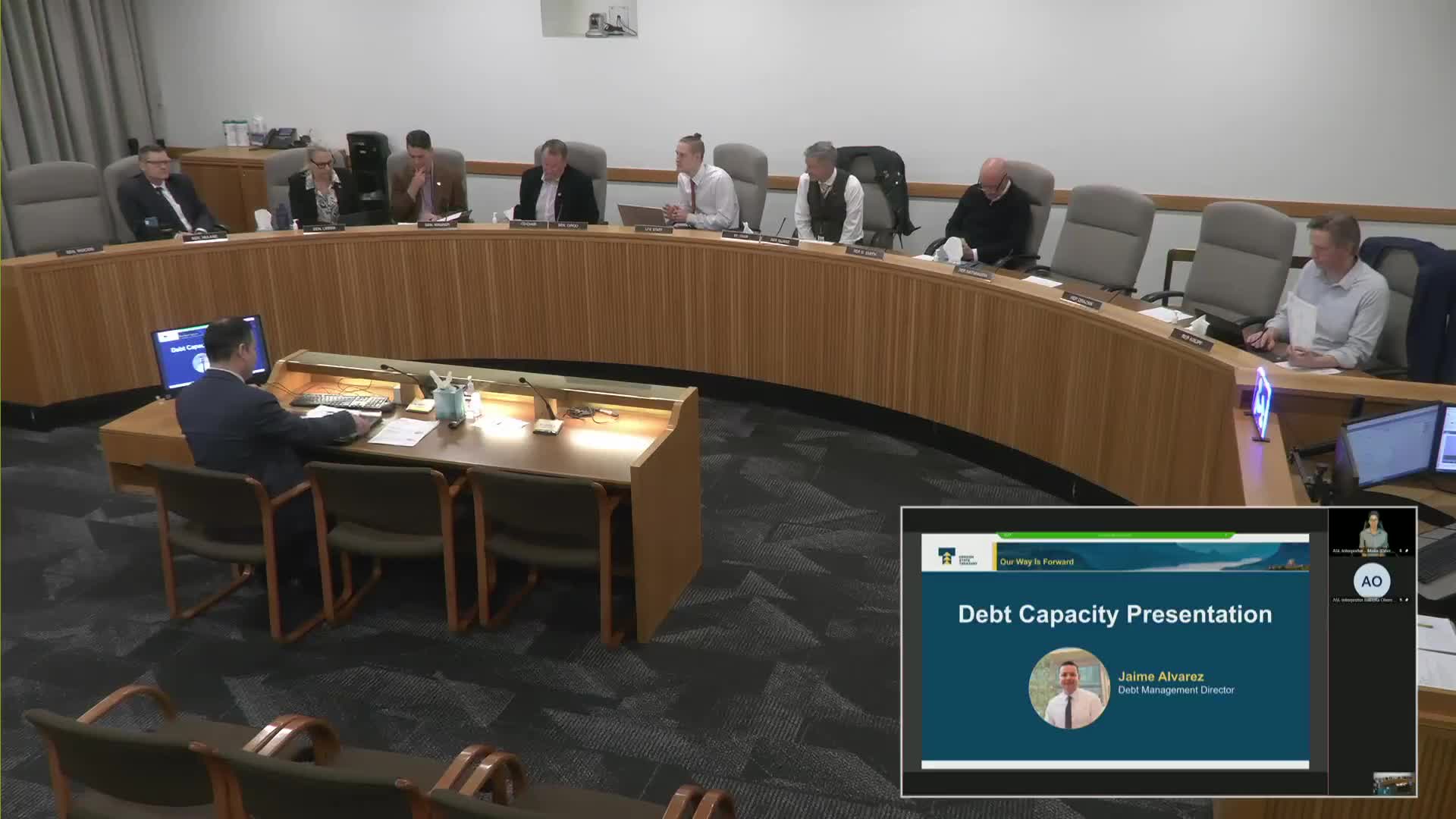
At a March 2025 informational meeting of the Joint Committee on Ways and Means subcommittee on Capital Construction, Oregon State Treasury and the Department of Administrative Services (DAS) presented the state's outstanding debt, credit ratings and debt-capacity forecasts that underlie the governor’s recommended bond package.
The presentations matter because the capacity calculations and interest-rate assumptions determine how much the state can responsibly authorize and issue for capital projects, including housing, university maintenance and state facility upgrades.
Jaime Alvarez, director of debt management at the Oregon State Treasury, told the committee that “in aggregate, we have approximately 12,800,000,000.0 outstanding and this is as of fiscal year end, 2024.” He said general-fund-supported bonds account for roughly $7.7 billion of that total, with about $5.5 billion in general-fund-supported debt and $2.3 billion tied to dedicated funds. Alvarez noted increased use of Article XI‑Q (state-owned property) bonds and continued use of the LIFT housing program as drivers of rising issuance.
Alvarez described the state’s credit profile as very strong and said rating agencies cite sound financial controls, stable budgetary position, growing reserves and very strong liquidity. He said the Treasury uses a 20‑year level debt‑service structure and a 5.5 percent interest‑rate assumption for the general‑fund debt‑capacity model.
Using the December 2024 revenue forecast, the Treasury reported a general‑fund debt capacity of about $8.9 billion over the full forecast period (four biennia), which averages to roughly $2.2 billion per biennium under an averaging approach the Treasury prefers. For lottery revenue bonds, the Treasury reported capacity of about $2.2 billion over the forecast period, averaging about $564 million per biennium, subject to the master indenture requirement that unobligated net lottery revenues provide at least four times coverage of maximum annual debt service.
Rhonda Nelson, capital finance manager at DAS, reviewed the governor’s recommended bond authorities and projects. Nelson said the governor’s budget used preliminary Treasury capacity guidance and recommended $2.2 billion in general‑fund‑supported general obligation bonds and $570.9 million in lottery revenue bonds. She noted the State Debt Policy Advisory Commission’s final January 2025 report revised some capacity figures downward relative to the preliminary September 2024 guidance, creating an amount that requires reconciliation with the governor’s package.
Nelson summarized recommended allocations in the governor’s proposal: about 40 percent of the general‑fund GO bonding authority for Oregon Housing and Community Services programs (LIFT and Permanent Supportive Housing), roughly 34 percent for state facility upgrades and IT capital projects, 13 percent for public university capital improvements, 7 percent for seismic rehabilitation grants, 5 percent for school district capital grants and 1 percent for community college grants. She said the governor’s package included $886 million of authority for LIFT and PSH programs and $200 million recommended for public university capital renewal.
On direct revenue and conduit bonds, the presentations listed roughly $2.5 billion of ODOT revenue bonds outstanding, $1.3 billion in lottery revenue bonds, $1.1 billion in housing program bonds and smaller amounts for other programs. DAS noted the governor’s budget also proposes authorizations for self‑supporting GO bonds and conduit financings (for example, housing development, industrial development and university facilities) that rely on dedicated revenues or borrower payments for debt service.
Committee members pressed Treasury and DAS on assumptions and sensitivities. Alvarez presented a sensitivity analysis showing a 10 percent decline in general‑fund revenues would reduce capacity by about $1.5 billion over the forecast period and that a 1 percentage‑point interest‑rate increase would lower capacity by roughly $200 million across the forecast. Legislators asked about per‑capita debt (Alvarez calculated about $3,200 per person, using the 12.8 billion figure), investor types (large institutional buyers and a growing retail investor base), and whether the state could reserve a portion of new issues for direct sale to Oregon residents; Treasury said that would require additional research and potentially federal and programmatic adjustments.
Committee members also requested follow up materials: a look‑back showing past forecast accuracy, a reconciliation of the governor’s proposed bond amounts with the State Debt Policy Advisory Commission’s final capacities, and an itemized list tying issued bond series to financed projects. Nelson said supplemental documents listing projects were provided and that agencies will present project‑level details throughout the session.
The subcommittee closed the informational meeting and announced it will hold a public hearing April 18 on Senate Bill 5505, the bond authorization bill included in the governor’s package.