Get Full Government Meeting Transcripts, Videos, & Alerts Forever!
Get email alerts on the Zoning.salem Street topic
No spam. Unsubscribe anytime.
Medford council adopts Salem Street corridor zoning and GreenScore standards after hours of public comment
Summary
The Medford City Council voted on March 11 to adopt a revised Salem Street Neighborhood Corridor District and a companion GreenScore environmental rubric after an extended public hearing and lengthy debate.
The Medford City Council voted on March 11 to adopt a revised Salem Street Neighborhood Corridor District and a companion GreenScore environmental-incentive rubric after an extended public hearing with about 70 speakers. The council approved the Community Development Board’s (CDB) recommendations with one change: it kept the Park Street/Salem Street node zoned MX‑2 rather than the CDB’s recommendation to downgrade that node to MX‑1.
The zoning package updates dimensional standards, adjusts permitted uses, and creates an incentive-zoning menu that lets developers earn discrete benefits for adding defined community or environmental features. Vice President Collins, who led the Planning & Permitting Committee through the proposal, summarized the aims before the council vote: “This proposal allows for moderately increased residential housing on Salem Street from the 93 Rotary up through Haines Square.”
Why it matters: the ordinance is part of a citywide rezoning aimed at matching local code to the city’s comprehensive plan, housing-production goals and climate strategy. Supporters say it will make small businesses legal where they already exist, create more housing close to transit, and give planners tools to require climate‑oriented design. Opponents said the changes were premature without neighborhood-specific traffic, infrastructure and shadow studies and warned of parking and displacement pressures.
Key changes and limits - Residential density and height: Most of the corridor remains limited to three stories by right in residential subdistricts; mixed-use subdistricts permit higher by-right heights in limited places. Through incentive zoning developers may be allowed to build up to four stories in some MX‑1 areas and up to six stories in MX‑2 or commercial subdistricts if they meet the proposal’s community‑benefit requirements; “incentive zoning increases are not allowed in multi‑unit residential subdistricts,” Collins said. - Uses: The proposal would allow ground‑floor commercial “by right” to help small businesses, but it also prohibits hotels and all marijuana commercial uses in the corridor. Boarding houses remain allowed only by special permit in some subdistricts. - Medical uses: The package narrows medical services on the corridor. A new defined use, “neighborhood medical office,” is limited in size and staffing and is permitted only by special permit in certain subdistricts. Planner Emily Innes summarized the limit at the CDB stage: neighborhood medical offices are constrained by area and staff and, in later drafts, operating hours. - Nonconformities and historic protections: The council heard that demolition‑delay and historic‑district tools already protect many buildings older than 75 years; the ordinance preserves established nonconforming‑use rules and points to Mass. Gen. Laws (chapter 48) for legal limits. - Design and buffers: The final recommendations include a minimum 10‑foot landscaped rear setback in MX‑1, MX‑2 and commercial areas and removal of a proposed upper‑floor stepback in MX‑1 (a change meant to avoid pushing upper floors closer to neighboring rear lots).
How incentives work The GreenScore rubric the council adopted adds a formal menu of environmental and streetscape credits developers can earn—examples include planted areas, green roofs, blue roofs and below‑grade parking—that can be used to obtain narrowly defined waivers or bonuses at the point of permitting. Vice President Collins emphasized the limits: incentive bonuses do not automatically raise the ordinance’s absolute height maximums; any bonus that would alter height still must comply with dimension tables and site plan review.
Public comment and council debate The council began the public hearing after the CDB returned a revised draft. Speakers were sharply split. Many residents and housing advocates urged the council to pass the corridor as a step toward more housing and walkable commerce, linking the proposal to climate and affordability goals. William Navarre told the council: “We’re ready for new zoning,” and other supporters said more housing is needed to keep young families and workers in Medford. Opponents — many of them residents who live on or immediately off Salem Street — asked the council to pause and require traffic, parking, sewer/water and shadow studies before adopting the changes. Speakers repeatedly raised concerns about emergency‑vehicle access, school‑pickup traffic and rising commercial rents that could displace existing small businesses. Several said they wanted a clearer, parcel‑level feasibility review before upzoning.
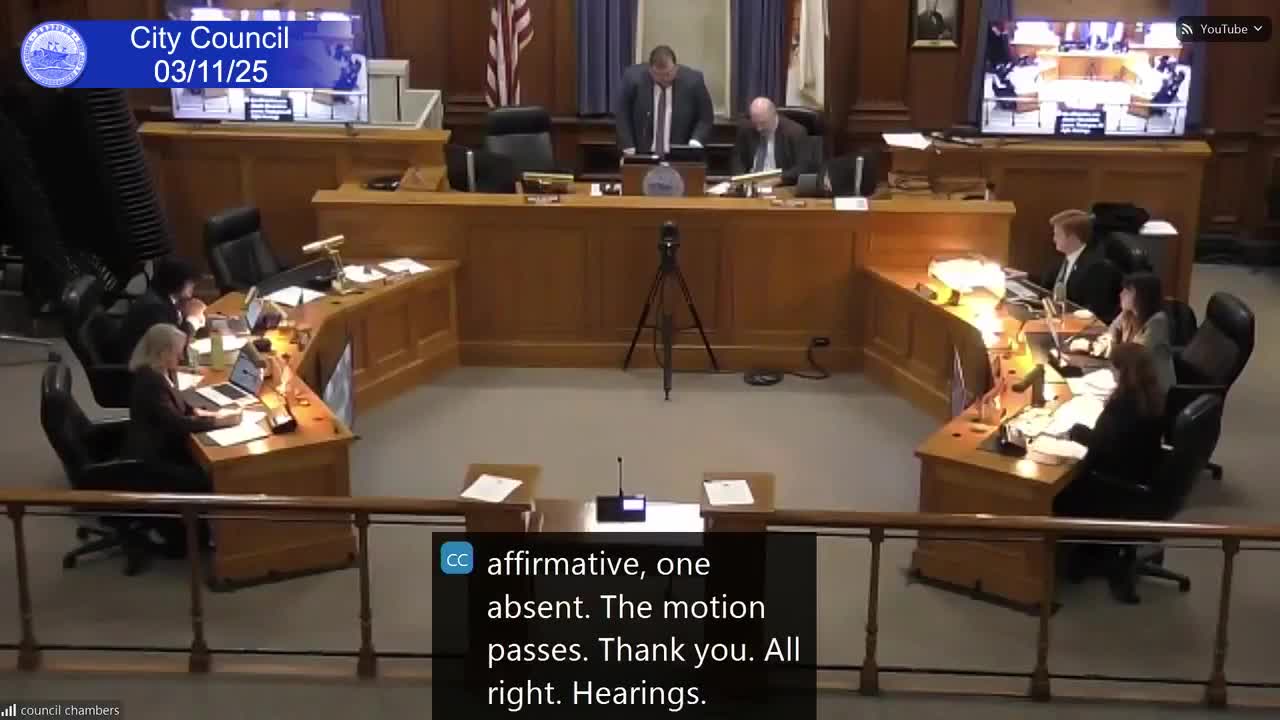
Council action - The council first voted to keep the Park Street/Salem Street intersection in the MX‑2 classification rather than accept the CDB recommendation to reclassify that node to MX‑1. That amendment passed by roll call (6–0, 1 absent). - The council then adopted the rest of the CDB’s recommendations and approved the zoning ordinance amendment (vote: 6–0, 1 absent). - The council separately approved the GreenScore rubric and its incorporation into site‑plan and incentive procedures (vote: 6–0, 1 absent).
What happens next The ordinance and the GreenScore rules will take effect under the city’s normal procedures for codification and permit review. Projects that exceed by‑right uses will continue to be reviewed through site plan and special‑permit processes; those project‑level reviews, councilors and staff said, are where traffic and impact studies are required and negotiated with applicants.
Councilors and planning staff said the rezoning is only one part of a wider implementation strategy that must include transportation improvements, stronger development review, municipal infrastructure investment and housing tools such as an expanded affordable‑housing trust and possible inclusionary linkage updates. Vice President Collins repeated that message at the close of the debate: “Zoning is one piece of a multi‑part strategy,” she said.
What the ordinance does not do The approved ordinance does not change parking minima citywide as part of this single package; the council and staff said parking rules will be addressed by later policy work. The GreenScore program and incentive menu do not permit unconditional height increases or automatic waivers; they operate at permitting and remain subject to the city’s site‑plan review and the statutory public hearing processes.
Outlook Medford’s Salem Street action joins earlier corridor updates (for Mystic Avenue and other sections) as part of a multi‑year, citywide rezoning effort. The decision is likely to accelerate permit filings in the corridor and trigger more project‑level site plan reviews — each of which will require traffic, stormwater and design studies and public hearings. The council’s adoption kept one contested node (Park & Salem) at a higher density allowance than the CDB had recommended, a sign of continuing negotiation between neighborhood concerns and development pressure.
Ending Councilors asked residents to continue engagement as drafts move to implementation and as specific projects arrive for review: many of the traffic and infrastructure issues raised by speakers will be handled at the project level, councilors said, where staff, boards and abutters have formal review rights.