Get Full Government Meeting Transcripts, Videos, & Alerts Forever!
Get email alerts on the Pedestrian And Bicycle Safety topic
No spam. Unsubscribe anytime.
Medford keeps bicycle-pedestrian safety resolution in committee after commission outlines priorities
Summary
The Medford City Council’s Committee of the Whole heard priorities from the Medford Bicycle Advisory Commission and invited speakers about pedestrian and bicycle safety, noted state and agency plans for two rotary improvements after recent fatalities, and voted to keep Paper 25,037 in committee for further work and budget planning.
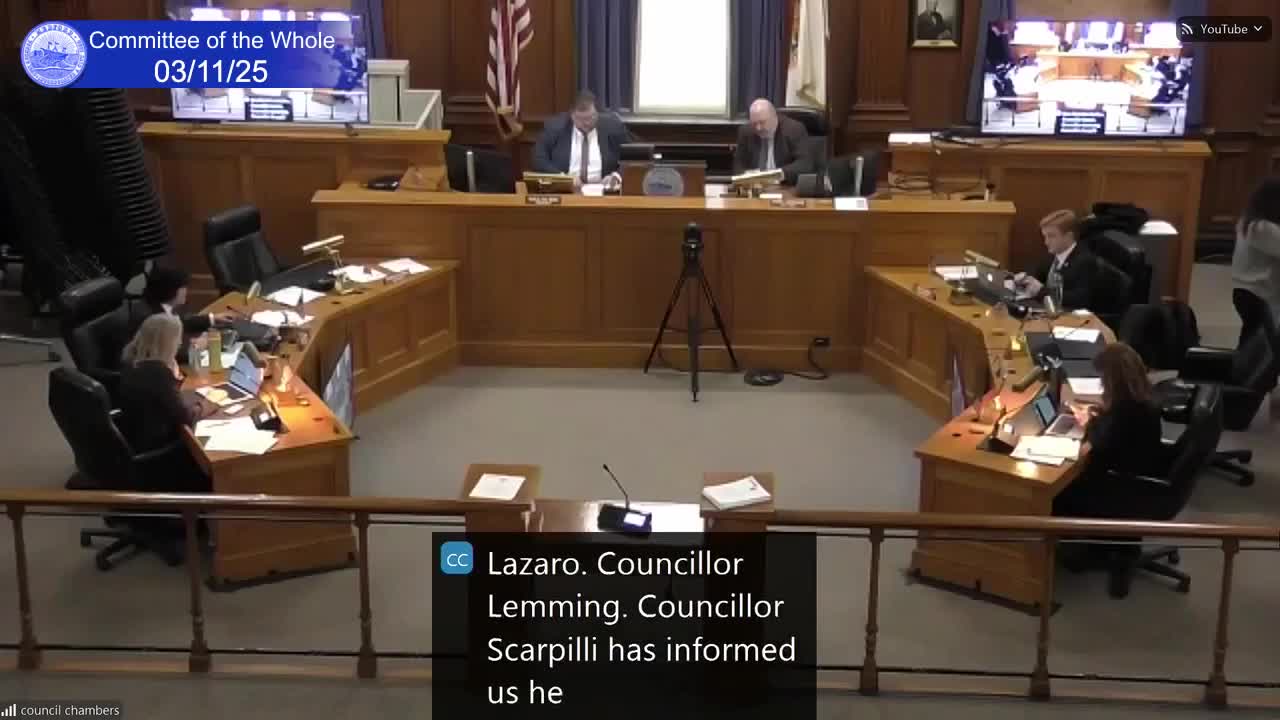
The Medford City Council’s Committee of the Whole on March 11, 2025 heard a presentation from the Medford Bicycle Advisory Commission and related speakers about pedestrian and bicycle safety and voted to keep Paper 25,037 in committee for further work and budget planning.
The discussion followed two recent pedestrian fatalities on state-controlled roads. Todd Blake, the city’s director of traffic and transportation, wrote that “the state, Mass Department of Transportation, Salem Street Rotary, and DCR, Misty Valley Parkway at Lakeview, and that High Street Rotary are working on plans to improve safety in these areas.” MassDOT’s concept plan for the Salem Street Rotary, shared by Blake, says it will focus on “realigning the curbing in and around the rotary to significantly reduce the width of the circulating roadway” and modifying radii to reduce travel speeds, with modifications targeted for implementation during this construction season as part of an I‑93 resurfacing project.
Why this matters: Councilors said the commission’s list of priorities will be used in upcoming FY26 budget discussions and in follow-up meetings about enforcement. Some safety steps can be done quickly on city-controlled streets; others — including work at the two rotaries cited — depend on state agencies and the Department of Conservation and Recreation (DCR).
Daniel Nuzzomuller, a resident who read the Bicycle Advisory Commission’s priorities for the record, urged the city to adopt broader goals and to pursue both short- and long-term changes. “It is perhaps very sad that we have to wait for a fatality to occur in order to see these improvements,” he said, and recommended the city consider committing to Vision Zero-style goals.
Emily O’Brien, identified in the record as chair of the commission, outlined the commission’s priorities for making bicycling a practical transportation option as Medford considers denser housing and zoning changes. O’Brien said the commission wants the city to pursue state and federal grants, expand the Blue Bike network, and prioritize repairs that pose hazards to cyclists, including potholes and obstructed bike lanes. She said the city should also fill the vacant position held previously by Amy Ingalls, which the commission viewed as an important point of contact for biking and pedestrian issues.
Commission priorities circulated and read into the record included: applying for state and federal funding for bicycle and pedestrian improvements; installing quality bike racks at regular intervals and ensuring private developments include racks when seeking city approval; advocating for protected bike lanes on high‑speed or multi‑lane roads where feasible; systemic traffic calming on neighborhood streets during repaving; continuing expansion of the Blue Bike dock network; prioritizing road repairs that threaten cyclists; adding signage and wayfinding for off‑street paths; developing neighborhood traffic calming plans; analyzing crashes and near misses and reporting annually; coordinating enforcement priorities with the Medford Police Department and the state police on state roads; improving snow removal on bike lanes and sidewalks; and public education about the 4‑foot passing law and the citywide 25 mph speed limit.
Councilors voiced support for moving recommendations into the budget process. Vice President Collins said she would “support any budgetary proposal that we submit to the mayor this spring for FY '26 to move the needle on these things that will make cycling safer in Medford.” Councilor Syng noted harassment and threats toward cyclists can be both criminal and civil offenses under Massachusetts law and urged enforcement and outreach.
City staff and councilors emphasized a difference in what the city can accomplish on its own streets versus state‑controlled roads. Blake’s email to councilors and the MassDOT concept plan were cited as evidence that some state projects are already being planned for the current construction season, but councilors said enforcement and other actions — such as restriping, pothole repair, installation of racks, and staffing for traffic engineering — will require budget decisions and coordination with departments.
Action taken: Councilor Leaming moved to keep Paper 25,037 (the pedestrian and bicycle safety paper offered by Councilor Rosaro) in committee; the motion was seconded (second not specified in the record) and the motion passed. The vote tally was not specified in the meeting record. Council leadership said the discussion will continue in future meetings, including a planned session on enforcement and in upcoming budget deliberations.
The committee asked the commission to provide prioritized items and estimated costs; the chair said she will “make it a priority as the chair to outline specific numbers and for these items at some point in the very near future.”