
Student representatives tell House Education committee student voice must be embedded in policy
Get AI-powered insights, summaries, and transcripts
Subscribe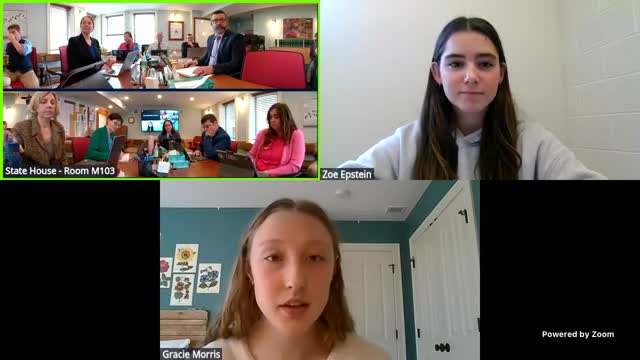
Summary
Three Vermont student board representatives told the House Education Committee on March 20 that students should have meaningful roles in school governance and budgeting, citing recent budget fights, outreach work, and pedagogical initiatives such as Harkness.
Three student representatives told the Vermont House Education Committee on March 20 that students must be intentionally included in policymaking about schools, budgets and curriculum.
"Students are at the heart of education, yet their voices are often left out of the decisions that shape their learning," Zoe Epstein, a junior at Champlain Valley Union High School and student representative on the Champlain Valley Union School District board, told legislators. "We believe that students deserve a seat at the table where policies, curriculum, and school experiences are designed with them, not just for them."
The students — Gracie Morris of the South Burlington School District board, Cashel Higgins, a student board representative for Harwood Union Unified School District and legislative intern, and Epstein — described how student representatives have taken part in budget education, community outreach and classroom-pedagogy initiatives. Gracie Morris said her district faced a difficult FY25 and FY26 budget cycle that prompted programs and staffing cuts and widespread anxiety among students and staff. She said student advocacy, including a student-led walkout and outreach, helped the district pass a budget on its third vote after two failures.
"Not only does having student representatives allow for school board members to make informed decisions, but our role has proven to be impactful when communicating with community members," Morris said. She described student activities including presentations to peers, voter-registration tables, media interviews and an op-ed in a local paper to explain the budget's importance.
Epstein described working with her superintendent and communications manager to create a presentation on the general education fund, property taxes, and the effects of Act 60 and Act 127 on statewide education funding. She said students reacted to the presentation with "fear and confusion," and that the experience underscored the need for students to understand fiscal decisions that shape their schooling. Epstein also said she reviewed the governor's original proposal and the text of H.454 and was struck by the lack of student voice in those legislative materials.
Cashel Higgins said student representatives in their districts do not cast binding votes. "We raise our hands and say yes or no, and then they take it into account, but it's not actually weighted," Higgins said, clarifying the advisory nature of the role.
The students also urged wider dissemination of effective classroom practices. Morris described the Harkness discussion method, first adopted by Harwood Union High School in 2016 and subsequently used at Champlain Valley Union, and said student groups have begun advocating to bring the method to South Burlington. She said students will present about Harkness during an upcoming teacher professional-development day.
Committee members responded with praise and questions about logistics. The committee asked for the students' written testimony to be submitted for posting so members could revisit it; staff member Annie was asked to receive the document. The deputy secretary of education, Jill Briggs Campbell, had provided the students a briefing, and Epstein said she serves on a Youth Policy Advisory Council organized by the Agency of Education and Up for Learning, with "under 10 students" from across the state attending so far.
The testimony was discussion-only; the committee did not take formal action during the students' appearance. Members indicated interest in preserving and expanding authentic student engagement as lawmakers consider larger structural changes to districts and governance.