
Committee gives conceptual approval to Skyline senior‑community skybridge, with public benefits conditions
Get AI-powered insights, summaries, and transcripts
Subscribe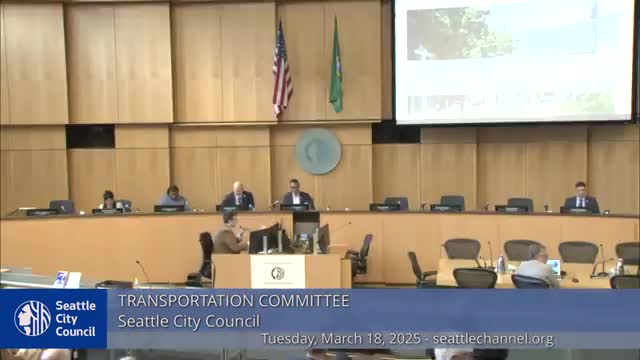
Summary
On March 18, 2025 the Seattle City Council Transportation Committee considered Resolution 32166 to grant conceptual approval for a pedestrian skybridge over Eighth Avenue connecting two Skyline senior facilities on First Hill; no final vote was taken and SDOT will return with term‑permit legislation if the resolution is adopted.
On March 18, 2025 the Seattle City Council Transportation Committee considered Resolution 32166, which seeks conceptual approval for a pedestrian skybridge over Eighth Avenue north of Cherry Street to connect two Skyline senior facilities on First Hill. The committee did not take a final ordinance vote; SDOT said it will return with term‑permit legislation later in 2025 if council adopts the resolution.
The project would link two adjacent buildings that the presenters said together house roughly 425 residents, many of whom use mobility aids. Michael Jenkins of the Seattle Design Commission summarized the central question for the commission: “What are the urban design implications of a new sky bridge? And then the second are, well, if we've solved the problem of urban design impacts, how do you mitigate through a public benefit package those impacts?” Jenkins said the commission voted to support the proposal largely because the applicant offered a multi‑part public benefit package.
Why it matters: the proposal is an exception to the city’s general presumption against private skybridges. Committee members and staff repeatedly framed the discussion around the facility’s medical and mobility needs, the project’s effect on the public realm, and whether the public benefit package adequately offsets the loss of pedestrian activity at street level.
Project scope and proposed public benefits
- Physical description: Mark Brand, landscape architect for the applicant, said the bridge is “over a hundred feet long” and “attaches directly to each building with no footings in the street.” SDOT staff said the bridge would be approximately 11 feet wide and would span a 66‑foot right of way.
- Public benefits (proposed by applicant): an on‑site publicly accessible open space/parklet at the Cascade Tower setback; public art developed in collaboration with artist Nori Sato; curb bulbs and pedestrian improvements at Eighth and Marion to shorten crossings and slow traffic; and a prototyped wayfinding program funded for the First Hill Park‑to‑Park loop and administered with the First Hill Improvement Association. The applicant provided a public benefits matrix that quantifies those improvements and lists their construction cost as an offset to the bridge’s pedestrian‑realm impacts.
- Maintenance and operations: SDOT said the permit holder (the applicant) will be responsible for long‑term maintenance and operation of the public benefits and that the city would not assume upkeep costs.
Regulatory background and precedent
SDOT staff explained that new pedestrian skybridges in Seattle are evaluated under the Seattle Municipal Code and reviewed by a skybridge review committee and the Seattle Design Commission. The city’s code limits the proliferation of private skybridges; most recent approvals in the past decade were for medical or civic uses. Amy Gray of SDOT said the last fully private commercial skybridge approvals include large medical campus projects (the Swedish Minor/Columbia examples were cited), and that the agency applies a high bar for private‑to‑private connections.
Committee discussion and public testimony
Several Skyline residents and representatives of the retirement community spoke in favor; speakers described mobility barriers between the two buildings, particularly in bad weather and for residents with walkers, wheelchairs or cognitive impairment. Council members from both districts that the bridge would span—District 7 and District 3—expressed support while noting the need to preserve street vitality and to hold developers to robust public benefits. Councilmember Sara Nelson Strauss emphasized the long‑standing city practice of limiting skybridges and said the commission’s recommendation and the public benefits package would be critical to justify an exception.
Next steps
SDOT recommended council conceptually approve the proposed pedestrian skybridge so the department can return with an ordinance for a term permit and finalize conditions, fees, insurance and bonding. If the committee adopts the resolution, SDOT said it will prepare legislation later in 2025 for council consideration. Presenters said several community organizations, including the First Hill Improvement Association, participated in benefit design.
Ending: committee members thanked Skyline residents for their advocacy and signaled general support for moving the project forward with a high bar for public benefits and detailed permit conditions. No final ordinance vote was held in committee; the resolution discussion was the conceptual step required before a term‑permit ordinance could be transmitted to council.