
Committee hears Sound Transit update on West Seattle, Ballard links as agency flags multibillion-dollar gap
Get AI-powered insights, summaries, and transcripts
Subscribe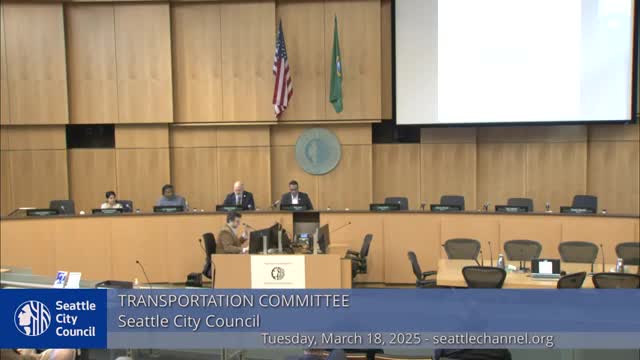
Summary
Sound Transit told the Seattle City Council Transportation Committee on March 18 that the West Seattle and Ballard Link extensions remain on a long timeline and face a multibillion-dollar funding gap; city staff described permit-streamlining and third-party funding roles the city may play to limit schedule-driven cost increases.
On March 18, 2025, the Seattle City Council Transportation Committee heard an update from Sound Transit on the West Seattle Link Extension and the Ballard Link Extension, projects included in the voter‑approved ST3 program that the agency said face significant cost and schedule pressure.
Sound Transit presenters said the West Seattle project remains in advanced planning with early property acquisitions underway and that the agency is preparing additional analysis of programmatic and project-level options to address cost increases. Jason Hampton, Sound Transit light rail development manager, summarized a key project benefit: “The project reduces travel time, from Alaska Junction to Westlake Station by 50%.”
The committee was told the agency currently reports a substantial funding gap for the West Seattle scope. Sound Transit staff said their current estimate for the West Seattle project is in the “roughly 6.8 to 7.2 billion” range and reported allocated funding of about $4.1 billion, leaving a multi‑billion‑dollar shortfall. Brad Owen, an executive in Sound Transit’s capital delivery program, described a multi‑pronged response being prepared under board direction, saying the board has directed staff “to develop a work plan on programmatic, project specific, and financial opportunities, to improve the agency's financial situation and and move the West Seattle, and Ballard projects through the design to inform, the project baseline.” Owen told the committee he expects clarification around costs to advance in the fall of 2025.
Why it matters: the two ST3 extensions are major regional investments that will change travel times and land use around stations, but escalating construction costs, materials and labor shortages, and schedule risk could re‑scope deliverables or require outside funding to maintain the currently selected alignments. Council members repeatedly tied those risks to questions about local impacts, displaced businesses, and what the City of Seattle can and should contribute.
Key details and timeline
- Construction timing: Sound Transit staff said planning has been underway since about 2017; they anticipate starting construction activities on West Seattle in 2027. The transcript included an expected opening date stated as “02/1932,” a notation that is garbled in the record; the agency did not provide a clear calendar date in committee. (The committee discussion treated the opening date as not specified.)
- Property acquisition and relocation: Sound Transit said it has received early approvals to acquire some properties and has begun outreach and relocation benefit conversations with affected owners and tenants. The agency noted formal property acquisition typically follows an FTA Record of Decision.
- Funding gap: Sound Transit gave a current estimate of roughly $6.8–$7.2 billion for the West Seattle scope versus approximately $4.1 billion in the agency’s allocated funding, creating the shortfall the board has directed staff to address. The agency indicated a combination of design, construction efficiencies and possible scoping changes may reduce the gap.
- Ballard Link: Sound Transit said Ballard is still in planning and environmental review. The draft environmental impact statement (EIS) is expected later in 2025, with a final EIS and board decisions anticipated in 2026 under the schedule presented.
City role and potential third‑party funding
City staff described two principal ways Seattle can affect costs: expedited permitting to reduce delay‑related cost escalation, and third‑party funding to cover discrete scope elements outside Sound Transit’s base financial plan. Angela Brady, director of the Office of the Waterfront, Civic Projects and Sound Transit, summarized the two roles as permit streamlining and third‑party contributions and said the mayor’s recent executive order adds staff resourcing and a work plan to support those activities.
City central staff noted that third‑party funding has precedent in the region—Calvin Chow cited Bellevue’s downtown tunnel contribution as an example—and said any option that requires new taxes or a citywide financing mechanism would likely require further review or voter approval. When asked whether recently approved Seattle levy funds could be used for third‑party contributions, staff said the levy ordinance does not authorize that use; levy funds tied to station access projects remain a separate, limited set of investments.
Public comments and committee concerns
Public speakers included Jordan Crowley, who identified himself as representing Alki Beach Academy and who said he supports the project while urging stronger local and legislative action to compensate nearly 70 businesses the speaker said would be displaced. Jack Wissner and other commenters expressed concerns about overall program costs and how scope choices will affect long‑term operations. One remote commenter called the full package “an over $12,000,000,000 boondoggle,” language the committee did not adopt; committee members emphasized the distinction between public comment and committee findings.
Councilmember Sara Nelson Strauss (committee representative on the Sound Transit board) said the board has changed its approach to sequential decision‑making so it can incorporate cost‑saving measures and avoid locking in prices prematurely. Strauss cautioned the city’s levy and local tax base are not large enough to fully resolve the program gap, and urged attention to the system‑wide “spine” that connects Everett to Tacoma when prioritizing investments.
Operational planning
Sound Transit outlined an interim operating plan in which West Seattle passengers would transfer at a downtown station to continue north or south on the system, with frequent bus service retained as parallel options by King County Metro. Long‑range maps presented how, once Ballard and other ST3 elements are delivered, lines would continue through downtown tunnel(s) and provide broader regional connectivity.
What’s next
Sound Transit said the board motion directing staff work on financial and programmatic options remains active and that the agency expects to present refined work plans and possible scope recommendations later in 2025. City staff said they will transmit legislation this year to streamline land‑use code provisions related to light rail facilities, bring forward a resourcing plan for ST3 city staff support (anticipated Q2–Q3 2025), and later propose ordinances to formally adopt particular project elements needed for permitting. The committee requested follow‑up briefings, including a later detailed Vision Zero safety briefing tied to at‑grade crossings.
Ending: committee members expressed strong interest in preserving community resources in impacted neighborhoods, minimizing construction impacts, and tracking board decisions. Sound Transit and city staff both said they will return with more detailed cost, schedule and permitting proposals for committee review.