Get Full Government Meeting Transcripts, Videos, & Alerts Forever!
Committee hears Sound Transit update on West Seattle, Ballard links as agency flags multibillion-dollar gap
Summary
Sound Transit told the Seattle City Council Transportation Committee on March 18 that the West Seattle and Ballard Link extensions remain on a long timeline and face a multibillion-dollar funding gap; city staff described permit-streamlining and third-party funding roles the city may play to limit schedule-driven cost increases.
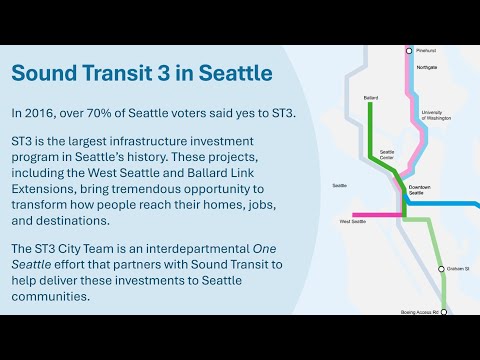
On March 18, 2025, the Seattle City Council Transportation Committee heard an update from Sound Transit on the West Seattle Link Extension and the Ballard Link Extension, projects included in the voter‑approved ST3 program that the agency said face significant cost and schedule pressure.
Sound Transit presenters said the West Seattle project remains in advanced planning with early property acquisitions underway and that the agency is preparing additional analysis of programmatic and project-level options to address cost increases. Jason Hampton, Sound Transit light rail development manager, summarized a key project benefit: “The project reduces travel time, from Alaska Junction to Westlake Station by 50%.”
The committee was told the agency currently reports a substantial funding gap for the West Seattle scope. Sound Transit staff said their current estimate for the West Seattle project is in the “roughly 6.8 to 7.2 billion” range and reported allocated funding of about $4.1 billion, leaving a multi‑billion‑dollar shortfall. Brad Owen, an executive in Sound Transit’s capital delivery program, described a multi‑pronged response being prepared under board direction, saying the board has directed staff “to develop a work plan on programmatic, project specific, and financial opportunities, to improve the agency's financial situation and and move the West Seattle, and Ballard projects through the design to inform, the project baseline.” Owen told the committee he expects clarification around costs to advance in the fall of 2025.
Why it matters: the two ST3 extensions are major regional investments that will change travel times and land use around stations, but escalating construction costs, materials and labor…
Already have an account? Log in
Subscribe to keep reading
Unlock the rest of this article — and every article on Citizen Portal.
- Unlimited articles
- AI-powered breakdowns of topics, speakers, decisions, and budgets
- Instant alerts when your location has a new meeting
- Follow topics and more locations
- 1,000 AI Insights / month, plus AI Chat