Get Full Government Meeting Transcripts, Videos, & Alerts Forever!
Get email alerts on the Mayoral Vacancy topic
No spam. Unsubscribe anytime.
Charter review panel considers line of succession, special-election timeline for mayoral vacancies
Summary
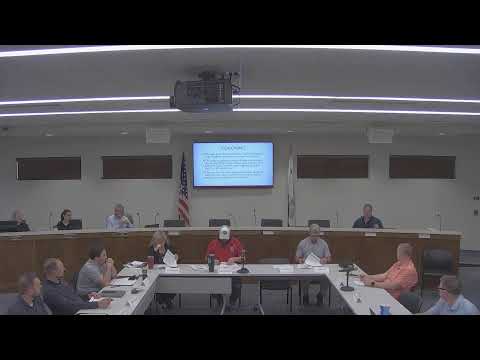
The Canal Winchester Charter Review Commission on March 25 examined options for filling a mayoral vacancy and proposed charter language that would limit how long an acting mayor serves and how a special election would be scheduled.
The Canal Winchester Charter Review Commission on March 25 examined options for filling a mayoral vacancy and proposed charter language that would limit how long an acting mayor serves and how a special election would be scheduled.
Commission staff summarized approaches used in other cities and presented draft language for Canal Winchester. Staff told the commission that some jurisdictions have the council president serve as acting mayor while a special election is scheduled, others permit the council to appoint an interim mayor, and some rely on an office such as a public advocate to act temporarily. The staff presentation noted that municipalities vary widely on timing, with some jurisdictions setting windows such as 60, 90, or 180 days for special elections.
Why it matters: the commission’s choices would establish who performs mayoral duties during sickness, death or vacancy and how quickly voters could elect a successor. Commissioners said they wanted to preserve Canal Winchester’s strong-mayor powers while ensuring continuity of government and minimizing cost to the city.
Key points from the commission’s discussion included: - Acting mayor and council seat: Under the draft language presented, a member of council who becomes acting mayor would continue to hold their council seat and the council presidency; the city administrator would assume day-to-day administrative duties. That approach was proposed to avoid automatically removing a council member from the council during a short-term acting period. - Voting and veto: Because an acting mayor who remains a voting member of council could not exercise a veto in the usual way, the draft would require a two-thirds council vote on legislation during the acting period — the same majority needed to override a veto — to preserve the strong-mayor checks embedded in the charter for a short interval. - Election timing: Staff proposed a 120-day deadline to hold an election to fill a permanent vacancy, with a 30-day signature period for candidates to get on the ballot; the draft ties special election scheduling to regular state primary/general election dates so the Board of Elections absorbs the cost when possible. - Line of succession and alternatives: Commissioners discussed adding a secondary line of succession if the council president declines to serve as acting mayor. One suggested option would be that, if the president declines, council could elect another council member to serve as acting mayor by majority vote.
Commission staff said the draft language attempts to combine local priorities — preserving the mayor’s veto and avoiding forcing a council member off council for a short-term acting assignment — with practical timetable limits so a voter election follows within months. Commissioners asked staff to clarify language on “incapacity” and temporary absence and to return with redlines addressing: a) how incapacity is determined, b) whether to keep provisions for temporary absences, and c) a clearer maximum interval for an acting mayor before an election is required.
Several commission members asked whether a medical determination should be required to find a mayor incapacitated; staff said examples from peer cities did not uniformly define medical standards and that the commission could add more specific language if it wished. The commission did not adopt final charter wording at the meeting and directed staff to produce revised draft language and redlines for the next session.
The commission also reviewed timelines for its own remaining meetings and agreed to continue work on the language so the packet can be finalized on the commission’s schedule.