
Greater Lowell Regional Vocational Technical presents FY 2026 budget; vote deferred pending Department of Revenue certification
Get AI-powered insights, summaries, and transcripts
Subscribe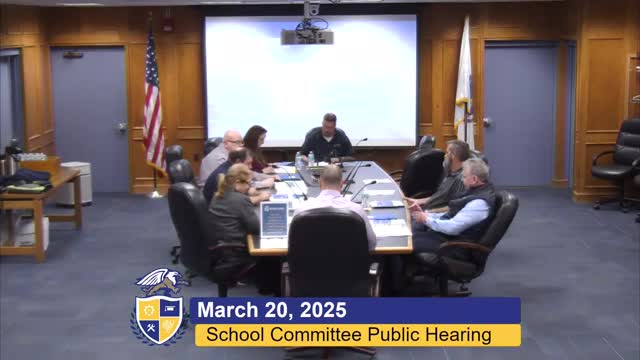
Summary
Superintendent Davis and Business Administrator Knight presented the Greater Lowell Regional Vocational Technical proposed fiscal year 2026 operating budget at a public hearing March 20, 2025, and the committee deferred a formal vote until the 6:30 p.m. regular meeting after the district’s use of $425,000 from its excess and deficiency fund remained uncertified by the Massachusetts Department of Revenue.
Superintendent Davis and Business Administrator Knight presented the Greater Lowell Regional Vocational Technical proposed fiscal year 2026 operating budget at a public hearing March 20, 2025, and the committee deferred a formal vote until the 6:30 p.m. regular meeting after the district’s use of $425,000 from its excess and deficiency (E&D) fund remained uncertified by the Massachusetts Department of Revenue.
The presentation recommended an FY 2026 operating total of $59,120,802 that included a planned $425,000 use of excess and deficiency to cover non–net-school-spending items such as vehicle purchases, a $270,000 career-center build-out and a $20,000 Medicaid filing. Because the E&D amount is not yet certified, the version presented for approval that night excluded the $425,000 and totaled $58,695,802.
The budget presentation, delivered to the committee by Business Administrator Knight, said the district’s foundation budget rose under the state’s Student Opportunity Act implementation and that per‑pupil rates changed for several categories: a vocational base of $17,354.29; special education at $32,114.34; and English language learner support at $3,575.49. Knight said the district’s low‑income weighting placed 54.11% of students in a low‑income category that yielded a per‑pupil figure of $7,815.03.
"We cannot vote the budget as it will be presented tonight as our excess and deficiency is not certified by the Department of Revenue currently," Knight told the committee, explaining why the $425,000 planned E&D use would be removed from the motion and added later by amendment if and when certification is received.
Knight said the proposed operating budget includes $55,600,722 in net school spending (the amount required to be spent on teaching and learning). Combined with transportation ($2,241,000), debt service ($1,253,280) and an OPEB contribution ($25,000), the full proposal reached $59,120,802; without the uncertified E&D the committee reviewed a $58,695,802 budget for approval that evening.
Knight outlined major line items and notable changes: instructional costs at $30,842,471 (the largest driver), administrative expenses at $3,698,520, and reductions in some other services lines driven largely by lower transportation costs after the district moved $770,000 from a prior year transportation reimbursement into a revolving fund to offset FY26 assessments. Knight cautioned that state transportation reimbursement design in the governor’s budget left uncertainty for some portions of aid, and he kept transportation reimbursement flat in planning to avoid a potential revenue shortfall.
Board members asked clarifying questions about several items. Board member Miss Charles asked what was included in the "other services" reduction; Knight said transportation was the largest single component of that change. Committee member John Piscione asked what vehicle purchases the E&D funds would pay for; Knight said the district planned to buy two 14‑passenger transit vans to support smaller team travel and offsite work‑study transportation, and noted the vans had produced net cost savings versus contracted bus trips.
Personnel changes included a $7,000 stipend for a CTE cluster chair who will assume additional departments (adding automotive technology and auto collision to an existing construction and transportation cluster), $16,192 for coaching positions to support unified sports and flag football (a varsity coach, assistant varsity coach and a JV coach), and a $10,000 increase distributed to noncontracted worksite aides ($5,000 each).
Knight said items that depended on the E&D certification — the vans, the career‑center build‑out and the planned OPEB contribution — would be proposed as a budget amendment once certification is complete, at which time the district would notify its member communities.
A public comment period produced no speakers. The committee voted to open and later to close the public hearing by roll call; the budget itself was scheduled for a formal vote at the 6:30 p.m. meeting that followed the public hearing.
The budget presentation noted the district’s assessed share among its sending communities totaled $18,865,202 (comprised of the minimum local contribution of $16,870,122, transportation assessment of $741,799 and debt assessment of $1,003,530). The presenter said Chapter 78 funding for the district stood at $38,330,600 under the state funding figures cited in the presentation.