Get Full Government Meeting Transcripts, Videos, & Alerts Forever!
Get email alerts on the Water And Sewer Rules Rate Change Process topic
No spam. Unsubscribe anytime.
Findlay committee recommends updated water, sewer rules to formalize quarterly rate-review process
Summary
The Findlay City Water and Sewer Committee recommended adoption of revised water and sewer rules that add a Q3 pro forma review to guide rate-change recommendations. Committee members also discussed multi‑year pro formas for bond rating purposes, inflation assumptions and the timing of a city master plan and long‑term control plan.
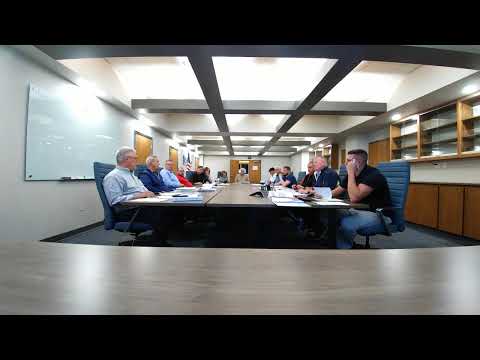
The Findlay City Water and Sewer Committee on an unanimous voice vote recommended that the City Council adopt updated water and sewer rules that formalize a third‑quarter pro forma review and clarify how rate changes are proposed and advanced.
The committee’s revisions insert a required administration presentation each third quarter that summarizes fund health, operating and capital needs, and—when appropriate—presents recommended rate changes for the committee to debate before any legislation or administrative change is made.
Why it matters: the changes set a repeatable, documented process so rate recommendations and underlying financial modeling are visible to the committee and to council. Committee members emphasized that multi‑year pro formas should be prepared when recommending rates so finance staff and potential bond underwriters can see the projected carryforwards and reserve impacts beyond the initial year.
The update makes the procedure for water and sewer parallel through the pro‑forma review but preserves a legal distinction under the Ohio Revised Code (ORC): administration retains authority to change water rates under existing ORC provisions, while sewer rate changes are to be advanced as legislation to the full council. The committee’s recommendation directs that the Q3 materials be presented consistently and that pro formas include scenarios showing (1) no rate change and (2) the recommended change and its multi‑year impacts.
Committee members spent substantial time on the financial presentation accompanying the rule changes. Several members asked that pro formas include: (a) forward‑looking multi‑year rate projections (not just the next budget year), (b) an explicit list of modeling assumptions (including the inflation and wage assumptions used), and (c) percentage metrics such as operating expense to revenue and capital to revenue to make year‑over‑year comparisons easier for elected members and rating agencies.
Staff said the binder provided to the committee now includes actuals for 2024, proposed 2025 figures, monthly rolling‑twelve revenue/expense comparisons for water, sewer and stormwater, and charts showing the cadence of revenue versus expenses. The committee asked that the document remain a “living” file and that a version be included in future quarterly KPI updates to council.
The committee also discussed longer‑term capital planning and debt. Staff said a placeholder debt service line (entered in the pro forma as an illustrative $500,000 annual payment in 2029) reflects that the utility will likely require borrowing tied to the upcoming master plan and the long‑term control plan; staff characterized that $500,000 as an illustrative placeholder, not a finalized borrowing amount. Committee members asked staff to annotate pro formas so external reviewers (underwriters, rating agencies) see which future‑year increases are assumptions for projection purposes and which increases have actually been approved.
On planning timelines, staff reported proposals from Arcadis were expected soon and that, after clearing EPA comments on modeling, the first draft of the long‑term control plan should be available in June. Committee members asked that master‑plan projects and any corresponding bond proceeds be shown in the capital side of future pro formas so the relationship between capital spending and debt service is clear.
Rob (staff) summarized the results of the prior rate change, saying the revenue results matched modeling: “The short version of that is yes … we are exactly where we thought we were going to be,” and explained the city needed to accumulate enough fund balance before issuing the master‑plan contract. The committee accepted staff’s recommendation and moved the updated water and sewer rules to the full council for consideration.
Votes at a glance: the committee made and seconded a motion recommending adoption of the updated water rules and sewer rules (motion text provided to council). The committee recorded a voice vote in favor; committee members verbally responded “aye” and no opposing votes were announced. The motion passed and the committee will forward its recommendation and minutes to city council.
What’s next: staff will refine the pro‑forma workbook to show (1) multi‑year rollforward scenarios tied to any proposed rate change, (2) explicit inflation and wage assumptions, (3) percentage metrics requested by members, and (4) capital projects and any corresponding bond proceeds as they become identified. Arcadis proposals and the first draft of the long‑term control plan are expected in the coming months and will inform future capital and rate modeling.