Get Full Government Meeting Transcripts, Videos, & Alerts Forever!
Get email alerts on the Capital Projects topic
No spam. Unsubscribe anytime.
Pembroke Pines keeps $60 million public-safety reserve while exploring design-build police station, staff says
Summary
City staff reviewed a $290 million strategic-plan project list and recommended retaining a $60 million restricted fund for public safety. Managers proposed pursuing a 12-month design‑build bid process for a new police facility and exploring surtax and grant options to fund transportation projects.
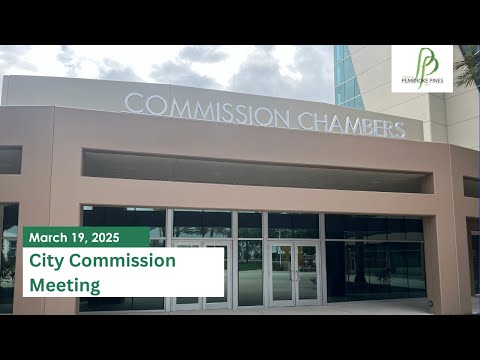
City Manager Tim Dodge told the Pembroke Pines City Commission on March 19 that staff recommends keeping a $60,000,000 restricted fund earmarked for public safety while the city pursues alternative funding and a design‑build procurement for a proposed police station.
Dodge said the city’s consultants and staff have identified about $290,000,000 in projects tied to earlier master plans and the strategic plan, and that roughly $60,000,000 of those funds are already in a restricted account. He told commissioners the previous architect’s estimate for a consolidated public‑safety facility was $110,000,000 and that a design‑build solicitation would give the city a firm “hard cost” within about 12 months.
The recommendation follows an overview of the strategic plan and a series of citizen town halls held while staff developed project lists for transportation, parks, economic development and community facilities. Dodge said staff is not asking for a vote but for direction and feedback from the commission on priorities and the financing approach.
Why it matters: The restricted account earns interest and was seeded in part with proceeds from wetland‑credit sales. Dodge told the commission the sale of wetland credits generated $13,000,000 in recent years, of which $10,000,000 was placed into the restricted public‑safety fund and $3,000,000 was used for Armstrong (Green) Park. Commissioners said retaining the fund keeps the city ready to move when a firm construction estimate is available.
Funding options discussed included grants, leveraging identified recurring revenue, and using a share of a proposed Broward County surtax amendment. Dodge said county staff is discussing directing roughly 10% of the surtax revenue to municipalities countywide; if adopted as described, Pembroke Pines could receive roughly $3,800,000 annually. Commissioners and staff noted that those figures were not final and remain subject to county approval.
Commissioners pressed staff on sequencing and timelines. Vice Mayor Goode asked how the county surtax carve‑out would be administered and whether the county would deduct existing countywide services from the 10% allocation; staff said their understanding — not finalized — is a straight 10% share. Commissioner Michelle Rodriguez emphasized traffic and enforcement needs in western neighborhoods such as Silver Lakes and asked staff to consider short‑term operational changes for police deployment if capital investments must wait.
Dodge also described economic‑development gains the city has realized by purchasing and repurposing large sites (including a closed prison site, a regional post office parcel and downtown city‑center property). He estimated those projects have created about $5,600,000 a year in new tax revenue, which reduces pressure to increase property tax millage.
Staff direction and next steps: Commissioners expressed consensus for the following steps — retain the $60,000,000 restricted fund, ask the architect to prepare a design‑build scope and cost estimate for a police facility, and return with a 10‑ to 15‑year capital‑project prioritization and financing plan. Dodge said staff will bring more detailed timelines and options to future budget‑visioning workshops.
Voices from the meeting: "It is my recommendation that we maintain that fund at this point as we move forward," City Manager Tim Dodge said. Vice Mayor Goode asked for a long‑range prioritized capital schedule, saying, "I'm very interested in at least seeing what a 10 or 15 year plan is." Commissioner Schwartz and others repeatedly stressed that public safety should remain the top priority.
Ending: Commissioners did not take a formal vote on a bond or borrowing strategy that night; instead they asked staff to return with refined cost estimates, potential grant sources and a multi‑year schedule that balances urgent transportation and public‑safety needs without immediately raising ad valorem rates.