Get Full Government Meeting Transcripts, Videos, & Alerts Forever!
Get email alerts on the Education Regionalization topic
No spam. Unsubscribe anytime.
Hampden and Wilbraham continue talks on regionalizing middle school amid dispute over capital-cost share and equity
Summary
Hampden and Wilbraham officials met March 19 to continue talks over a proposed amendment to the Wilbraham–Hampden regional agreement that would designate Wilbraham Middle School as a regional middle school and change how capital costs are apportioned between the towns.
Hampden and Wilbraham officials met March 19 to continue talks over a proposed amendment to the Wilbraham–Hampden regional agreement that would designate Wilbraham Middle School as a regional middle school and change how capital costs are apportioned between the towns.
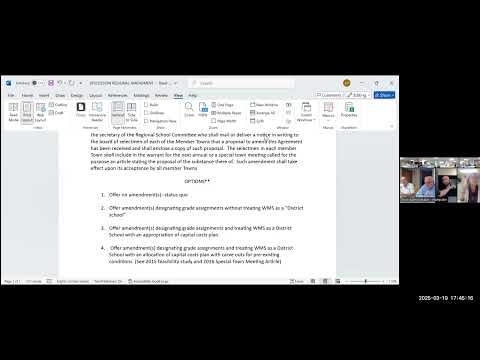
The discussion focused on four options under consideration: leave the current arrangement unchanged; assign grade responsibilities without reclassifying the building as regional; reclassify the building as regional and apportion capital costs by enrollment under a capital-cost plan; or transfer ownership to the regional district (for example, selling the building to the district for a nominal fee) so both towns share equity and capital responsibility. The meeting did not include a formal vote.
Officials said the proposed amendment would require Department of Elementary and Secondary Education (DESE) approval and would be placed on a town-meeting warrant for each community. Officials also raised concerns about language in the existing lease that could cause automatic termination if the district reorganizes or is dissolved, and asked counsel to clarify those provisions before any final action.
Hampden participants repeatedly pressed for clarity about how capital investments by Hampden taxpayers would be protected if the building became a regional property that could later be sold. Several speakers said taxpayers in Hampden currently pay roughly 18–19% of shared operating costs and stressed they want some mechanism to recover or recognize capital contributions—particularly for large, long-lived items such as boilers or a roof—if the asset left local control later. Officials discussed possible approaches including proration for mechanicals, time-limited depreciation schedules, or a formula to credit capital contributions toward any future sale proceeds.
Wilbraham and district representatives said the district’s draft amendment would treat the building as a regional facility and apportion agreed capital costs by enrollment, and that capital proposals would continue to be reviewed by both towns’ capital planning processes. District representatives also noted recent work on the building: participants said approximately $1.8 million has been invested since 2015 (speaker estimates varied) and that a roof project and other repairs have been completed. The meeting record includes an approximate figure of $700,000 cited for air-filtration or HVAC work currently being discussed, but officials did not present a single, agreed list of capital requests at the meeting.
Attendees flagged several building-condition issues raised in earlier reports and public discussion, including a past mold incident that participants said the state Department of Public Health has deemed remediated. Sam Boyd, identified in discussion as the district facilities director, was referenced regarding testing and the district’s participation in state programs; participants asked staff to confirm the most recent testing dates and documentation.
Participants exchanged examples from Minnechaug (the district’s regional building that was built as a regional school and is jointly owned) to illustrate how ownership and capital apportionment differ when a building is developed as regional from the start. Hampden officials said that difference—owning equity from the outset versus being asked later to fund capital work in a building they do not own—is central to taxpayer concern.
On process, officials agreed to continue the dialogue and requested a more specific proposal from Wilbraham/district staff enumerating pending capital needs, projected costs, and suggested language to address equity or credit for contributions. Hampden officials also asked counsel to review lease language that might cause automatic termination of the lease in the event of a reorganization or withdrawal. Participants identified DESE review as a critical step and noted the timeline for a formal amendment had been pushed toward the fall town-meeting season, leaving several months for negotiation.
As a next step, the two select boards agreed to reconvene to continue the discussion; participants settled on a follow-up joint meeting on April 2, 2025, at 5:30 p.m. No formal votes on the amendment or capital commitments were taken at the March 19 meeting.
The conversation leaves several open items: a detailed, itemized capital proposal from the district; counsel review of lease termination language; documentation of recent testing and remediation for environmental concerns; and a mutually acceptable method to account for Hampden’s capital contributions if the building’s ownership changes in the future. DESE approval and the separate town-meeting processes in both communities remain necessary steps before any amendment could take effect.