Get Full Government Meeting Transcripts, Videos, & Alerts Forever!
Get email alerts on the Land Use Appeals topic
No spam. Unsubscribe anytime.
Board of Zoning and Building Appeals urges change to de novo appeals standard, highlights disability‑accommodation gap
Summary
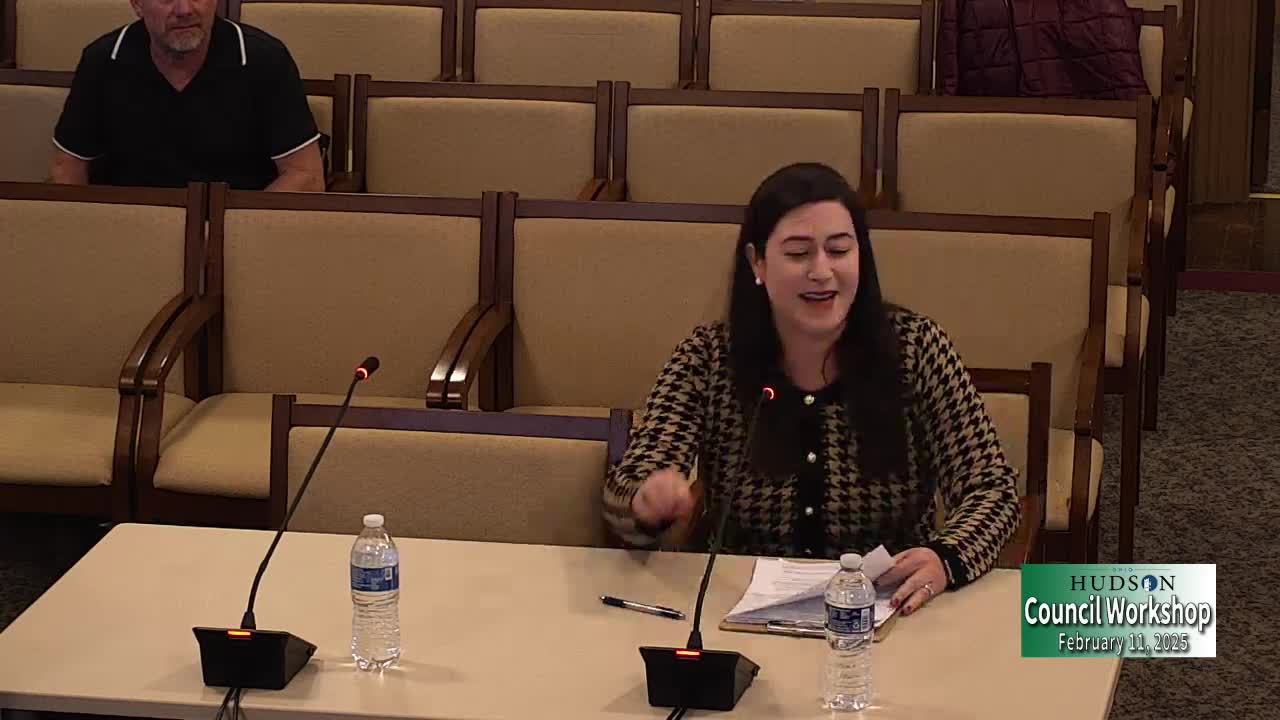
Hudson City Council workshop — Lydia Braunstein, a member of the Board of Zoning and Building Appeals (BZBA), told council on Feb. 11 that the board has seen a marked increase in appeals in recent years and recommended the city consider changing the appeals standard so the board does not have to rehear cases de novo.
Hudson City Council workshop — Lydia Braunstein, a member of the Board of Zoning and Building Appeals (BZBA), told council on Feb. 11 that the board has seen a marked increase in appeals in recent years and recommended the city consider changing the appeals standard so the board does not have to rehear cases de novo.
Lydia Braunstein said the BZBA met 10 times in 2024 and heard 17 variance applications and three appeals. “A majority of the cases that we hear are typically variances,” Braunstein said. She told council that between 2023 and January 2025 the board handled six appeals from the Planning Commission and the Architectural and Historic Review Board, compared with only one appeal in the prior seven years.
Why it matters: Braunstein and councilmembers argued that a de novo review—where the appeals body rehears the entire case—has become impractical and can duplicate work already done by the body that heard the original application. Braunstein said the BZBA often lacks clear findings of fact from the original decision, making it difficult to determine the basis for appeals.
Board concerns and recommendation: Braunstein said the BZBA members favor a different standard—examples mentioned included “abuse of discretion” or review limited to whether the prior decision included legally sufficient findings of fact. She explained that without written findings of fact from the initial board, the BZBA must spend lengthy deliberations trying to discern the original decision‑makers’ reasoning.
Disability‑related reasonable‑accommodation procedures: Braunstein also highlighted a separate gap. She described a recent case (the 61 Sussex Drive matter) that raised questions about how the land development code handles reasonable accommodations or modifications requested on the basis of disability under ADA and fair housing law. She said few neighboring jurisdictions provide an explicit administrative pathway and recommended Hudson add clear guidance in its land development code or an accessible flowchart on the city website clarifying whether such requests go to the zoning board or another administrative route.
Council response and next steps: Councilmember Skyler said he has heard the same concern from other boards and encouraged fast action on revising the appeals standard. Councilmembers and staff said they would take the de novo question up with legal counsel and consider drafting changes in code or council procedure. The BZBA said it had started compiling a searchable database of prior decisions to reduce reliance on institutional memory and improve consistency.
The council did not take action at the workshop but directed staff to consider options, including changes to the code’s appeals standard and clearer procedures for disability‑related accommodations, and to return with recommended language.