Get Full Government Meeting Transcripts, Videos, & Alerts Forever!
Get email alerts on the Recreation Center topic
No spam. Unsubscribe anytime.
Hudson council subcommittee presents early feasibility findings on proposed recreation center
Summary
City subcommittee reported a preliminary financial feasibility assessment for a proposed recreation center, finding a $5–7 million build may be possible within existing financing but that operational costs and community willingness to pay remain unresolved.
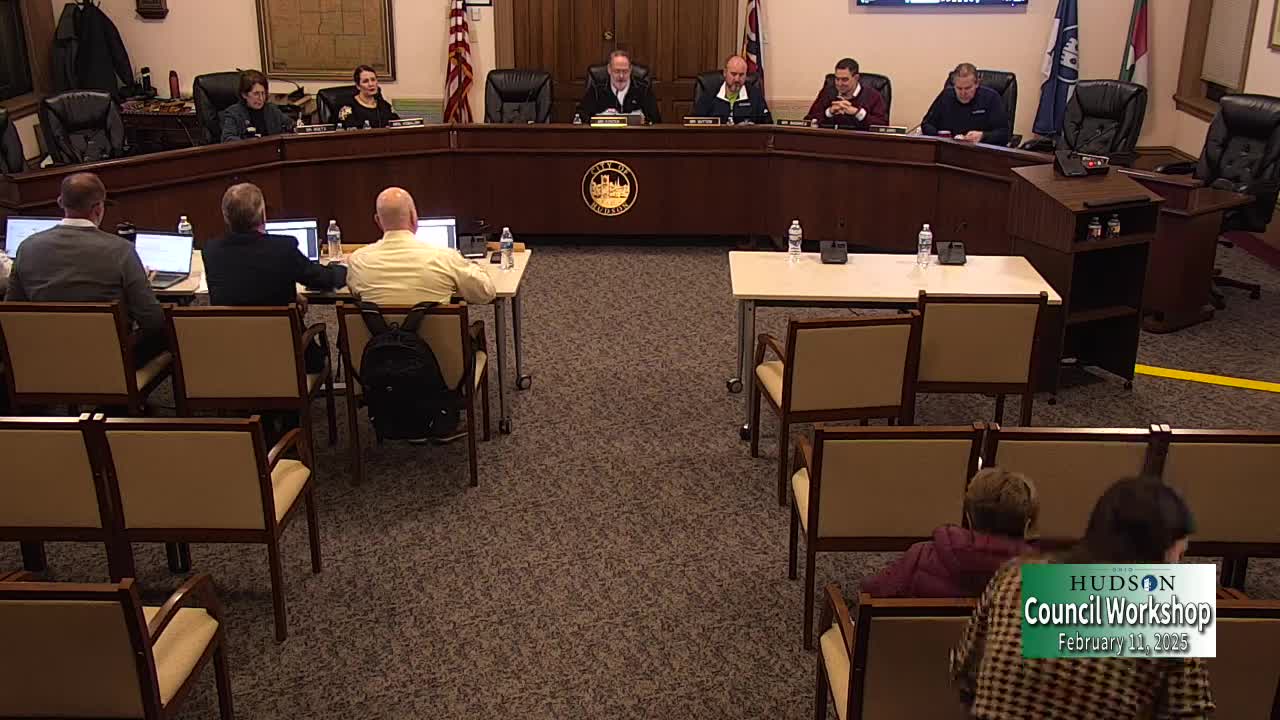
Hudson City Council workshop — A city subcommittee on Feb. 11 presented the first phase of a financial feasibility review for a proposed Hudson recreation center, saying initial analysis suggests the city could afford a $5 million to $7 million facility without a new tax levy but that long‑term operating costs, community willingness to pay and site questions remain unresolved.
The subcommittee and staff framed the work as a financial feasibility step, not a design or final plan. Tom, a city staff member leading the study presentation, said the review was intended to “understand the financial feasibility of a rec center, rather than get into planning the landscaping and the pool and all that upfront.”
Why it matters: The potential center was listed as a priority in Hudson’s 2024 comprehensive plan. Council members said the community survey results include strong interest in both outdoor and indoor pools but also show many respondents unwilling to pay more than modest annual fees, making it difficult to reconcile desired amenities with expected household contributions.
Council and staff described the subcommittee’s main findings and next steps. The group compiled a matrix of regional recreation offerings and rate studies (examples cited: Stow, Twinsburg, Wadsworth, Mentor, Macedonia, Cuyahoga Falls) to compare amenities and revenue models. Tom said the subcommittee found no nearby facilities that break even year‑to‑year; pools typically increase operating deficits. Staff also reported one pathway that could reduce construction costs: acquiring and renovating an existing private facility, as one neighboring city did after acquiring a club for about $5 million and renovating it for roughly $2.5 million.
Councilmembers and staff emphasized three outstanding issues the subcommittee must resolve before any bond or ballot proposal: operational costs (which depend on the facility program), what residents would pay and whether a phased approach is preferable. Councilmember Dr. Byrd noted the comp‑plan survey showed conflicting signals: strong interest in indoor pools and outdoor amenities but low stated willingness to pay. Councilmember Kowalski asked whether the $5–7 million estimate included debt service and operating costs; staff said the figure covered only physical construction with debt financing and not ongoing operations or equipment.
Council discussion also covered partnerships and alternatives. Staff reported outreach to the YMCA and local school district; the YMCA described models in which multiple public and private partners share a facility. Other options mentioned included offering incentives for residents to join regional centers, using existing city‑owned land with phased buildouts, or renovating an existing municipal building for partial use (including a potential re‑use of a former fire station for senior programming).
Next steps: The council signaled support for a market feasibility and community willingness‑to‑pay study by an outside consultant before pursuing a voter levy. Tom said the subcommittee would return with cost estimates for consultant work and additional analysis within roughly six weeks. Council members also indicated they were not prepared to put a large levy—such as $50 million—on this year’s ballot.
The subcommittee presented detailed comparative matrices and asked staff to refine scenarios that map amenities to likely price points and taxpayer impact. The city will return to the council with consultant cost estimates and community survey options to narrow choices and specify operational assumptions.