Get Full Government Meeting Transcripts, Videos, & Alerts Forever!
Get email alerts on the Labor Contracts topic
No spam. Unsubscribe anytime.
Union and district at odds over implementation of presidential-release leave after arbitration ruling
Summary
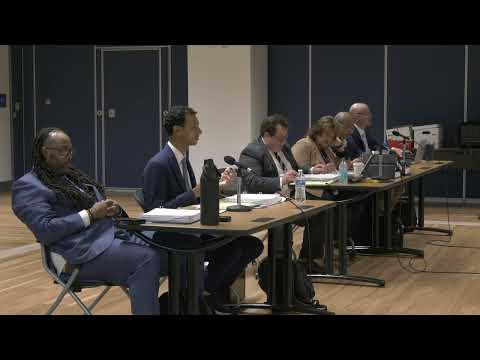
Martin County Education Association leaders and school district officials clashed Tuesday over whether the collective-bargaining provision that allows the union president to take a yearlong unpaid presidential release should remain and how it should be implemented.
Martin County Education Association leaders and school district officials clashed Tuesday over whether the collective-bargaining provision that allows the union president to take a yearlong unpaid presidential release should remain and how it should be implemented.
The disagreement follows an arbitration ruling that sided with the union on the underlying interpretation of the release provision and sent implementation details back to the parties to negotiate. Martin County Education Association representatives said the release helps union officers do their work during the school day; district officials said the provision posed administrative and legal complications that required careful written procedures.
The union argued the district’s prior implementation for a former president was routine and workable. "It worked the same way that it worked in my other district," said former MCEA President Karen Resiniti, describing the earlier arrangement in which the union prepaid salary and the district ran the payroll and benefits administration. Current union witnesses said the arrangement allowed release-time presidents to respond to teacher issues during the day rather than after classes.
The district’s bargaining team described multiple administrative points that needed resolution before it could implement a release year routinely: how a released president would be evaluated, to whom the released president would report, how benefits and retirement contributions would be handled, and indemnification if the released employee was not a district payroll regular. Jeff Slinker, counsel for the school board, told the hearing that "under Florida law, a school board cannot pay or compensate an employee to do work for a union," and that draft MOU language was intended to address the compliance and operational issues that flow from a paid-through-district implementation.
Gary Simmons, Treasure Coast Service Unit director for the Florida Education Association, described the post-arbitration negotiations as extensive: "bargaining began with, 6 sessions solely discussing the president's release language," he said, summarizing the amount of bargaining time devoted to the issue.
Union leaders said the district’s later proposal to remove the presidential-release language altogether felt like a reversal after the arbitration outcome and prior discussions about implementation; the union testified that the arbitrator’s decision required the parties to negotiate the mechanics, not to abolish the right. MCEA President Matt Theobald said he was put back in the classroom this school year after the parties could not finalize the implementation language; "I was placed on unpaid instructional leave," he told the hearing, describing how the disagreement affected his employment and benefits.
The parties produced a multi-page draft memorandum of understanding designed to spell out evaluation, reporting, payroll pass-through procedures, and insurance and retirement treatment. The MCEA witnesses said previous practice and similar arrangements elsewhere in Florida informed their proposals. The district said the MOU needed additional detail to protect the district from financial and compliance risk.
Where the matter stands: arbitrator findings and prior implementation practice are part of the hearing record, but the parties have not executed an implementation agreement for the current request. The hearing record contains draft MOUs, administrative exhibits and testimony describing the operational steps that remain disputed.
The special magistrate will consider the parties' evidence, the arbitrator's decision and the detailed implementation proposals before issuing a recommendation. In the meantime, the union and district remain at impasse on whether and how a released-president year should be implemented.
Provenance: topicintro evidence begins when the union first framed presidential leave in opening remarks (transcript block starting at s=116.50) and topic discussion continues through the arbitrator/MOU testimony and related exhibits (last related segment around s=5338.76).