Get Full Government Meeting Transcripts, Videos, & Alerts Forever!
Get email alerts on the Program Evaluation Scheduling topic
No spam. Unsubscribe anytime.
Legislative Audit Commission adopts new timing for program evaluations and asks OLA for list of prior audits
Summary
The Legislative Audit Commission voted to adopt a revised schedule for selecting program-evaluation topics and directed the Office of the Legislative Auditor (OLA) to provide the topic-selection subcommittee with a compiled list of prior evaluations for future follow-up.
The Legislative Audit Commission voted to adopt a revised schedule for selecting program-evaluation topics and directed the Office of the Legislative Auditor (OLA) to provide the commission’s topic-selection subcommittee with a compiled list of previously completed evaluations for future consideration.
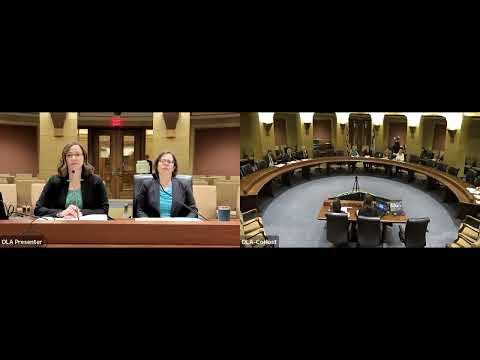
The change centers on how and when the commission chooses evaluation topics. Deputy Legislative Auditor Jody Munson Rodriguez told the commission that the office’s prior practice was to select about five to six topics once per year, with each evaluation taking roughly 10 months to complete. She said that schedule creates inefficiencies and periodic gaps in staff work and proposed alternative timing models to create a more continuous workflow.
The commission adopted what members referred to as the “first proposal,” a scheduling change designed to let OLA concentrate work in set periods while releasing reports throughout the year rather than clustering them in mid‑session. Representative Quam moved to adopt the first proposal, and the motion passed on a roll call vote, 10 yes to 1 no. The lone recorded no vote was Representative Hansen. The chair announced, “There were 10 yeses and 1 no.”
Earlier in the meeting the commission approved, by voice vote, a separate motion to request that OLA supply the topic-selection subcommittee with a list of prior program evaluations to inform future follow-up choices. Senator Droskowski moved that motion; the chair called the voice vote and said, “Motion prevails.”
Why it matters: commissioners and OLA staff said the scheduling change is intended to improve staff flexibility, reduce bottlenecks when employees are unavailable, and allow OLA to stagger staffing so some reviews can begin as others finish. Munson Rodriguez described a third option (selecting a larger slate annually and allowing staff to scope and sequence work) but commissioners favored the first proposal’s approach to shortening an initial spring slate so follow-ups and smaller reviews can be scheduled more deliberately.
During discussion several members urged that the topic-selection subcommittee be given access to completed evaluations going back multiple years so it can identify appropriate follow-ups. Commissioners debated how far back the list should go — suggestions ranged from five to 15 or 20 years, and one member proposed maintaining a continuous historical list going back to the beginning of OLA’s records so staff would only need to update it going forward. OLA said it can prepare such a list and be flexible about the date range.
The meeting also included an OLA briefing on bills that reference the office. Legislative Auditor Judy Randall described two small, housekeeping bills (listed as House File 1239 and Senate File 1773) that would align certain reporting requirements between state agencies and the state auditor; Randall said neither had been heard in committee yet. Randall also summarized OLA’s policy bill (identified in the packet as House File 1240 and Senate File 1772), which would establish a special reviews division in statute, clarify when agencies must report certain matters to OLA, expand OLA’s special-review authority to include allegations of noncompliance with legal requirements beyond public-money matters (for example, licensing complaints), and authorize follow-up special reviews. Section 7 of that policy bill would repeal an obsolete IT-audit provision (cited in the briefing as 16B0.45).
Several commissioners raised concerns about potential overlap between a proposed Office of Inspector General in other legislation and OLA’s work. Chair Rest said she would be “very, very extremely protective of the independence of the OLA” and warned against creating duplicative oversight structures.
Speakers and contributions were recorded throughout the discussion. Munson Rodriguez summarized the timing options and the staff-efficiency rationale; Randall presented bill summaries and the proposed statutory clarifications; commissioners questioned the scope of the list of prior evaluations, the cadence of topic selection, and potential partisan influence during the subcommittee selection process. Representative Hansen opposed the timing-motion roll call, and several other members urged continuing a nonpartisan approach to topic selection.
The commission adjourned after completing the agenda items on program-evaluation timing, the request to OLA for a historical list of evaluations, and the briefings on bills affecting OLA’s reporting and review authorities.