Get Full Government Meeting Transcripts, Videos, & Alerts Forever!
Get email alerts on the Horticulture Muscadine Pruning topic
No spam. Unsubscribe anytime.
UF Extension demonstrates dormant-season pruning for Muscadine grapevines in Okaloosa County
Summary
Larry Williams of the University of Florida Extension Office in Okaloosa County led a field demonstration in February showing tools, timing and technique for pruning Muscadine grapevines, emphasizing leaving 2–4 buds per fruiting spur, spacing spurs 4–6 inches and pruning during dormancy.
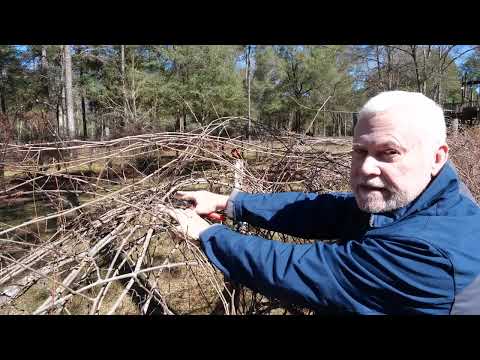
Larry Williams, horticulture agent with the University of Florida Extension Office in Okaloosa County, demonstrated how to prune Muscadine grapevines during a field session in February, covering tools, timing and the cuts that produce fruiting wood.
Williams said the native Muscadine grape requires significant annual pruning while the plant is dormant and recommended doing most pruning in January or February — pruning may begin as early as late December and extend into early March if necessary. “This is a must have,” Williams said, referring to a hand pruner, which he described as the tool most used when pruning a grapevine. He added that loppers are useful for larger cuts and pruning saws are only needed for old, nonproductive trunks.
The demonstration focused on removing most of last year’s runners and retaining short fruiting spurs on the main arms. Williams advised leaving 2 to 4 buds on each fruiting spur — he typically left three on the examples he showed — because spring growth from those buds produces the shoots that will flower and bear grapes. He said ideal spacing for fruiting spurs is about 4 to 6 inches along the arm.
Williams warned that fresh pruning cuts often “bleed” sap and that is normal: “People get upset about that, but it’s normal. The grapevine will deal with that. It will seal over within hours, and it'll quit dripping.” He recommended completing pruning before the vine leafs out so new shoots develop from the retained buds.
On cultivar and harvest timing, Williams said Muscadines are a native Southeastern U.S. grape with many selections and cultivars available — “probably 200–300 different cultivars or varieties” — and that most varieties produce fruit in July through September, with some late varieties carrying into October or early November.
For training and support, Williams showed how to reattach and support arms using soft ties (he used Velcro-style straps during the demonstration) and noted brands for pruning tools, including Corona and the higher-end Felco pruners. He closed by directing listeners to local Extension resources: “I hope you learned something with this demonstration on how to prune Muscadines.” He gave the University of Florida Extension in Okaloosa County phone number as (850) 689-5850 and said Master Gardener volunteers are available to help with gardening questions.
Practical takeaways from the demonstration: prune Muscadines during dormancy (ideally January–February), remove most last year’s runners, keep short fruiting spurs with 2–4 buds spaced about 4–6 inches, expect short-term sap bleeding from fresh cuts, and contact the UF Extension Office in Okaloosa County or Master Gardener volunteers for more guidance.