Get Full Government Meeting Transcripts, Videos, & Alerts Forever!
Get email alerts on the Housing Development Pud topic
No spam. Unsubscribe anytime.
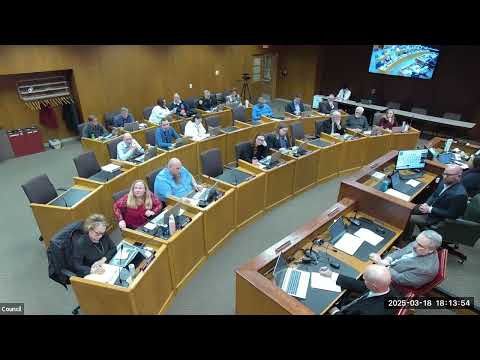
Council holds large Red Smith-area PUD after hours of testimony on traffic, flooding and habitat
Summary
After more than three hours of public comment and council discussion, the Common Council voted 7–5 to hold a proposed planned unit development (PUD) for a 168-acre Red Smith-area site, citing resident concerns over traffic, stormwater and protection of the Niagara Escarpment.
The Green Bay Common Council voted 7–5 March 18 to hold consideration of a planned unit development (PUD) and related zoning changes for a large Red Smith-area site until the council’s next meeting on April 15.
Developer Brad Reimer and others presented a plan for roughly 168 acres east of Red Smith School that would include about 227 single-family lots, nine duplex lots, roughly 160 multifamily units (depicted in the proposal as about 10 apartment buildings) and roughly 30 acres of dedicated open space. Reimer described site work already completed — topographic surveys, wetland delineations, and stormwater sizing — and said the net density would be lower than buildable scenarios previously allowed by older plans.
Supporters of the project included the Realtors Association of Northeast Wisconsin, whose representative, Jennifer Sundstrom, said the region faces a long-running housing shortfall and urged approval, calling the mix of housing types “what we have been asking developers to do.” The developers also said they would oversize stormwater ponds and work with the city to reduce off-site runoff.
Opponents — including two dozen residents and neighborhood representatives — raised traffic and student-safety concerns at Red Smith School, repeated accounts of repeated past flooding and basement water intrusion, and ecological worries about the Niagara Escarpment and rare species. Multiple residents said they moved into the neighborhood because the adopted comprehensive plan calls for low-density residential uses and said multifamily buildings and smaller lots would change the area’s character.
City staff and the developer responded to technical questions: staff said the city’s comprehensive plan encourages a mix of housing types in new neighborhoods and that PUDs can be used to implement those goals; planning staff and an outside engineer advised council that private drives and the site’s contours were reasons the multifamily component had been placed where proposed. Director Renier Wigg told council, “We have always said, from the beginning that this is one parcel. We chose the downtown zoning because that’s actually a more comprehensive zoning option,” and said a legal description from the owner would be required to create a separate parcel.
Council members debated competing issues: the need for more housing citywide; the neighborhood’s expectation of lower-density development; traffic circulation and whether new outlets (for example, Durham Road) or traffic-calming measures could be pursued; and stormwater engineering solutions. Several council members urged additional work with the developer and staff before a final vote.
Alder Proffitt initially moved to approve the PUD and Alder Presley seconded; the motion was interrupted by a separate motion from Alder Grant to hold the PUD until April 15, seconded by Alder Eck. After more debate the council voted 7–5 to hold; the mayor announced the motion passed and the item will return April 15 for further action.
Why it matters: The PUD would add hundreds of housing units and alter land use patterns on more than 100 acres in northeast Green Bay. Neighbors said the proposed mix would strain local streets and school drop-off routes and risk worsening flooding; proponents said the design responds to the city’s stated need for mixed housing types and that new development could reduce some runoff by building modern stormwater infrastructure.
What happens next: The PUD will return to the council’s April 15 meeting; in the interim staff and the developer will continue technical work on traffic, stormwater and ecological impacts and the council may receive additional information or amendments.