Get Full Government Meeting Transcripts, Videos, & Alerts Forever!
Get email alerts on the Fy26 Budget topic
No spam. Unsubscribe anytime.
Chariho committee debates FY26 priorities, pre-K aid changes and Hope Valley options; schedules Feb. 25 follow-up workshop
Summary
Committee members pressed the administration for line-item detail, discussed a state recalculation that reduced pre-K aid by $242,357 across the three towns, debated returning fifth graders to elementary schools and heard administration estimates tied to taking Hope Valley Elementary offline; the panel scheduled a Feb. 25 follow-up budget workshop.
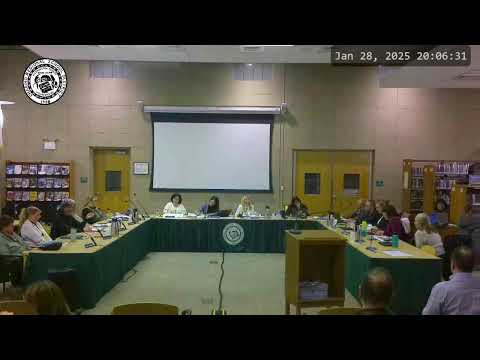
The Chariho Regional School District School Committee spent its budget-workshop meeting focused on the proposed fiscal year 2026 operating budget, airing questions about line items, state aid changes for pre-kindergarten, options for grade reconfiguration and facility planning, and possible savings tied to taking Hope Valley Elementary School offline. The committee voted unanimously to schedule a follow-up budget workshop for Feb. 25 from 6 to 8 p.m.
Why it matters: committee members said the FY26 proposal is the administration’s recommendation for preserving academic programs while meeting contractual costs and facility needs. Members pushed for clearer line-item detail, asked for options for a “level-funded” budget comparison, and pressed the administration for estimates of savings and downstream impacts if a school is closed or if fifth graders return to elementary schools.
Pre-K state-aid recalculation
Finance staff told the committee that late guidance from the Rhode Island Department of Education required the district to reclassify the funding status of many pre-K students (part time versus full time). The administration reworked the numbers and reported a reduction in state aid tied to those reclassifications: a decrease of $17,217 for Charlestown, $94,499 for Richmond and $130,640 for Hopkinton, a combined reduction of $242,357. The finance staff said they adjusted the FY26 one‑page summary to reflect the change.
Grade reconfiguration and capital planning
Several committee members, including Councilor Jess Purcell and others, raised the recurring idea of returning fifth graders to elementary schools to improve academic outcomes and possibly reduce later costs. Superintendent Gina Picard and Assistant Superintendent Dr. Camilla explained that such a change would require engagement with the state School Building Authority and a multi-stage facilities application process (stage 1 and stage 2), plus new architectural and schematic work that would increase capital planning costs and could not be completed for FY26. Picard said the district’s current renovation plan would not accommodate moving fifth grade back to elementary buildings without major additional expenditures.
"You could create a stage 2 application for the elementary, including grade 5, but you'd have to increase the cost of the engineering and architecture," Picard said, noting stage 2 applications can be submitted twice a year.
Staffing and program questions
Committee members asked detailed questions about benefits and how the district allocates health care, pension and fringe costs across school codes (UCOA reporting). Finance and human-resources staff said contracts constrain many benefit line items and that moving from leasing to outright purchase for technology hardware changed where costs appear in the budget (lease lines down, purchase lines up).
Middle-school staffing also drew scrutiny. The middle school currently has one dean (listed in some discussion as 1.2 earlier during staffing changes); administrators argued that deans perform behavior and safety work that allow principals and assistant principals to focus on instruction. Assistant Superintendent Dr. Camilla warned against cutting dean positions and said doing so would shift discipline work back to administrators and reduce instructional time.
Custodial overtime and facilities upkeep
Committee members questioned a rise in custodial overtime and the district said vacancies and event staffing (evenings for athletics and recreation) have driven overtime costs; those vacancies have started to fill. The facilities budget also reflected increases for field maintenance, fertilizer, snow plowing and helmet reconditioning required by athletic-safety rules.
Hope Valley Elementary: line-item estimates and staffing implications
The administration provided a line-item breakdown of costs and potential savings tied to taking Hope Valley Elementary School offline and redistributing students to other buildings. Staff identified specific service and staffing line items connected with Hope Valley that would shift if the school closed or was repurposed, including:
- Busing for Hope Valley: $85,000 (line-item estimate cited by administration) - Maintenance and utilities assigned to Hope Valley: $195,000 (administration estimate) - Capital spending associated with Hope Valley (current FY planning): $95,000 (administration estimate) - Classroom staffing (examples): two grade‑1 teacher FTEs (~$200,000), one grade‑2 FTE (~$100,000) - Nurse, custodian and one teaching‑assistant positions (administration cited typical line-item costs: nurse ~$100,000; custodian ~$60,000; TA ~$40,000)
Administrators said some staff reductions would be achieved by leaving positions unfilled or by shifting employees to vacancies at other schools; collective-bargaining rules and seniority considerations would affect assignments. Finance staff offered a per-item accounting for services and staffing tied to Hope Valley for committee review and said they would publish a consolidated list for members.
Fund balance, grants and contingency planning
Committee members debated whether to increase the district’s fund balance. The finance team reported the current target was 2.25 percent of the operating budget and explained that raising the target to 2.5 percent would add roughly $160,475 to the FY26 budget (administration estimate included during discussion). Several members asked for a stronger contingency given uncertainty in grant funding; the superintendent noted the district’s recent grant receipts and cautioned that federal and state funding levels can change.
Other specifics and follow-up requests
- The district said $3 million in grant revenue appears in the proposed FY26 budget and that the composition of those grants (federal, state) may change; the committee urged caution and a stronger fund balance if grants decline. - Committee members asked for a “level-funded” scenario and for an option that would show a smaller reduction target (for example, a halfway point between the proposed budget and full level funding). The administration said it can produce those scenarios if the committee specifies which programs or dollar targets to examine. - Members asked for visibility into benefits coding and UCOA allocations; administrators noted confidentiality limits but pointed to publicly available collective-bargaining appendices and contract language for benefits detail.
Votes at a glance
- Motion to schedule a follow-up budget workshop for Feb. 25, 6–8 p.m.: moved by Laura (last name not specified in transcript), seconded by Larry (last name not specified in transcript); outcome: approved unanimously. - (Earlier in the meeting) Motion to approve budget transfer for mandated well-tank cleanings: outcome recorded as unanimous approval (see separate item).
What’s next
The committee agreed to a Feb. 25 follow-up budget workshop to continue line-item review. Members asked the administration to prepare: (1) a level-funded budget scenario (with the committee to indicate which programs to protect or cut), (2) a consolidated list of items previously funded with ESSER and whether those costs remain in the FY26 operating budget, and (3) a compiled, line-item breakdown of the Hope Valley savings/options for the committee to review in writing before the next workshop.
Direct quotes in this article are attributed only to speakers identified in the meeting transcript and appear as provided by the administration and committee members during the public session.