Get Full Government Meeting Transcripts, Videos, & Alerts Forever!
Get email alerts on the Labor Policy topic
No spam. Unsubscribe anytime.
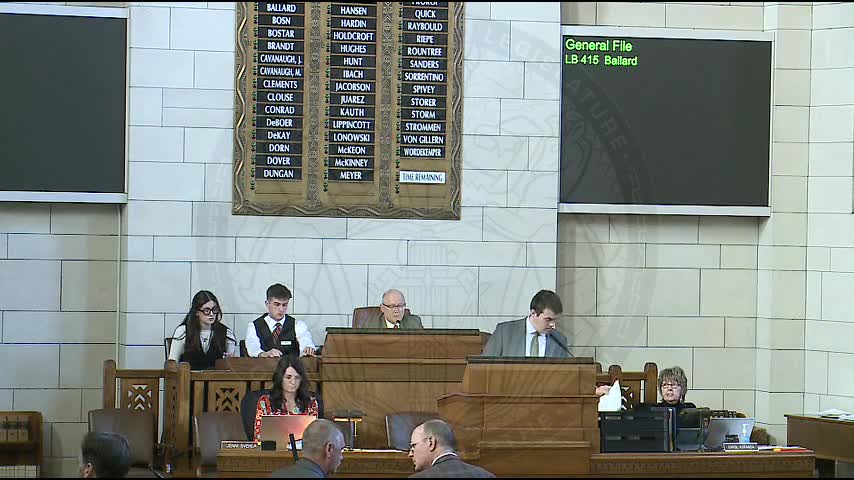
Floor debate intensifies over paid sick leave; motion to indefinitely postpone fails
Summary
Lawmakers debated LB415 and related amendments intended to clarify the paid sick leave ballot initiative; a motion to indefinitely postpone (MO110) failed on a roll-call vote.
The Nebraska Legislature held an extended debate March 20 over LB415, a bill described by its sponsor as cleanup language for the voter-approved paid sick leave initiative. Lawmakers delivered lengthy floor remarks on whether clarifying language would implement — or undermine — the will of voters who approved the ballot measure.
Why it matters: The paid sick leave initiative received strong voter support last year, and senators disagreed on whether statutory cleanups are needed or constitute an attempt to roll back the initiative. The floor debate centered on definitions, employer coverage, accrual and payout rules, and whether exemptions for small employers should be added.
What the bill and its supporters say Sponsor Senator Ballard described LB415 as a cleanup bill to clarify the voter-approved initiative so employers and employees understand definitions such as paid time off (PTO), accrual caps and how PTO interacts with separations in employment. Ballard said the bill preserves PTO plans that already meet the initiative’s hour requirements and clarifies that accrued sick leave need not be paid out on separation in certain rehire circumstances. He said the measure was developed with input from business groups, employment-law practitioners and the Department of Labor.
What opponents and other senators said Senator McKinney, who moved to indefinitely postpone LB415 (Motion MO110), argued the Legislature must respect the ballot result and not erode the will of voters; he cited that roughly "75% of Nebraskans voted for paid sick leave" and said his district recorded 92% support. Multiple senators (including John Kavanaugh, Duncan and others) emphasized that voters in virtually every legislative district supported the measure and warned against substantial rollbacks. Senator Conrad said removing or weakening elements of the initiative would be "offensive" to voters who organized and campaigned for the measure.
Conversely, other senators urged clarifying statutory language or exempting smaller employers. Senator Sorrentino argued the body has an obligation to provide administrable statutory language where the initiative left limited text, and he cited federal precedent that small employers may be exempt from some leave rules to avoid disproportionate administrative burden.
Procedural votes on the floor - Motion to place LB415 on indefinite postponement (MO110): failed on a roll-call vote, 11 ayes, 32 nays (motion did not carry). The vote count was read into the record by the Clerk. - A separate motion to cease debate passed earlier (31 ayes, 11 nays), and the body then proceeded through the reconsideration and procedural steps described on the floor.
Clarifying details discussed on the floor Speakers referenced specific operational mechanics from the ballot initiative and LB415 or related amendments: accrual of one hour of paid sick leave per 30 hours worked; a cap of five days (40 hours) per year for some employees and seven days (56 hours) per year for others; the initiative’s 80-hour threshold before accrual starts; and an estimate cited on the floor that "250,000 Nebraskans who work full time do not get any paid sick days."
Ending: The floor debate continued through multiple procedural motions. The motion to indefinitely postpone failed; the bill remains in play and further amendments or votes are expected on subsequent days. Senators urged colleagues to consider the ballot returns in their districts as the Legislature moves forward.