Get Full Government Meeting Transcripts, Videos, & Alerts Forever!
Get email alerts on the Renewable Energy Property Taxation topic
No spam. Unsubscribe anytime.
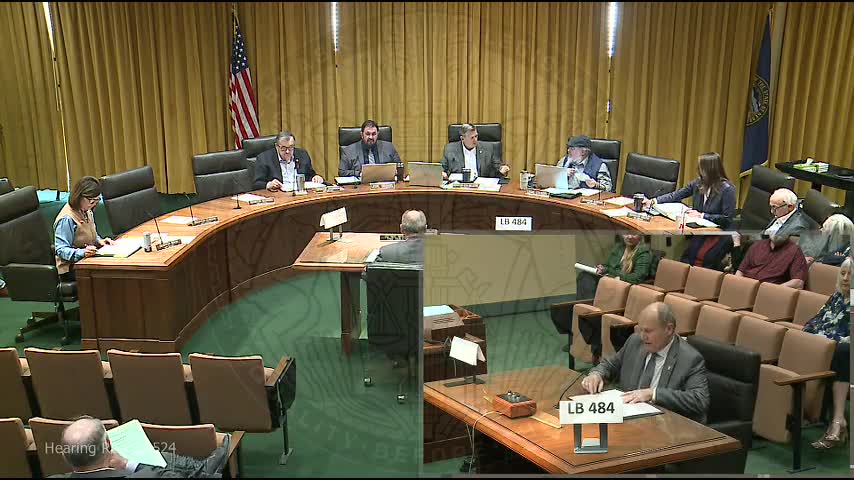
Neb. revenue committee hears bill to restore agricultural classification for land with renewable projects
Summary
Sen. Dan Quick and proponents told the Revenue Committee that LB484 would repeal a 2024 statutory change that county assessors and developers say created ambiguity about when agricultural land loses its preferential assessment because of wind or solar installations.
Senator Dan Quick (R-35) introduced LB484 to the Revenue Committee, saying the bill “would repeal an exemption from agricultural land valuation imposed on land used for commercial purposes” and restore a long‑standing approach to classifying land used primarily for agriculture regardless of limited commercial installations on the parcel.
The measure responds to language in last year’s LB1317 that, proponents said, inserted conflicting guidance into Nebraska statutes. Proponents told the committee the Department of Revenue issued Directive 24‑3 in September that instructed assessors to value land associated with a renewable energy facility at 100% of market value; at the same time older statutory language (cited in testimony as “Nebraska revenue statute 77‑6203 subsection 4”) and long practice set a distinct treatment for agricultural and horticultural land.
Why it matters: Developers, county assessors and industry representatives warned the committee that the conflict leaves too much discretion in local assessment decisions and could cause different counties to treat similar parcels differently. David Bravid, a registered lobbyist for Catalyst Public Affairs representing Invenergy LLC and NextEra Energy Resources, told the committee that in typical wind projects the company will lease a whole 60‑acre quarter section but the turbine pad and infrastructure often occupy “under a half, at most 1 acre,” raising the question whether one turbine would reclassify the entire quarter as commercial property or only the small footprint.
Supporters argued that restoring the prior statutory approach would preserve predictability for farmers, assessors and renewable developers while ensuring counties continue to receive the nameplate capacity tax that accompanies utility‑scale projects. Quick and witnesses cited the state’s roughly 3.5 gigawatts of installed wind capacity and testimony that counties receive about $12,000,000 a year in nameplate capacity tax revenue tied to those projects.
County officials gave neutral testimony, saying the current statutory language creates real confusion for assessors. John Cannon, executive director of the Nebraska Association of County Officials, explained that assessors are directed to value a parcel as a whole and then determine the parcel’s primary use; that context makes the absence of a clear statutory definition for “solar farm” or “wind farm” a practical problem for valuation work.
Questions from committee members touched on practical consequences. Witnesses said easements and leases commonly cover entire farm parcels even though the renewable facility footprint is small; they also noted differences between wind and solar projects (solar arrays can occupy larger contiguous acreage than a typical turbine). Several senators encouraged the introducer to consider narrowly tailored clarifying language while acknowledging the bill’s goal to resolve an internal statutory conflict.
The committee did not vote during the hearing. Quick asked the committee to advance LB484 for further consideration.
Ending: The committee heard no opponents in person. Proponents and neutral witnesses largely framed the bill as a technical fix to restore the pre‑existing assessment approach, and multiple testifiers urged clarity so assessors, landowners and developers know how to treat parcels with renewable energy facilities.